Understanding Federalism: Powers and Structure of Government Levels
This overview explores the concepts of federalism, unitary, and confederate governments, illustrating how powers are distributed between national, state, and local governments. The document discusses the origins of government powers, profiles significant federal agencies involved in law enforcement, and highlights the implications of the Supremacy Clause in the U.S. Constitution. By analyzing historical contexts, such as the Articles of Confederation, we aim to clarify the strengths and weaknesses of different governmental structures and their practical impacts on governance.

Understanding Federalism: Powers and Structure of Government Levels
E N D
Presentation Transcript
Federalism CH 4
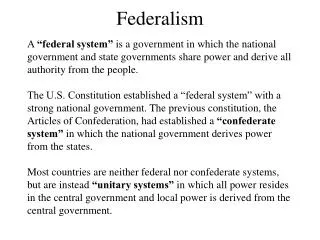
Unitary Government • Local and state governments receive their powers from the central government and are under its control. • Why not? • Great Britain has a unitary system of government.
Confederate Government • A loose association of states organized for a limited purpose (like defense). • Why not? • The Articles of Confederation allowed the separate state governments to be stronger than the national government which led to lots of problems
Federalism • Powers of the government are divided between a central government and state/local governments. (Both levels of government act directly on the people.) • Why? • We wanted a stronger national government but were scared of giving it too much power
The “Beltway Sniper” Investigating Agencies • Montgomery County Police Department • The Bureau of Alcohol, Tobacco, Firearms and Explosives (ATF) • The FBI • The Secret Service
Powers of the National Government • Anything listed (expressed) or implied in the Constitution as a national power. • Any inherent powers of the government (to show a united front to foreign powers) • War • Regulating commerce
Powers of the State Government • Create a republic form of government • Charter local governments • Conduct elections • Any powers not given to the national government
Concurrent (shared) Powers • Tax citizens and businesses • Borrow and spend money • Establish courts • Pass and enforce laws • Protect civil rights
Supremacy Clause • Article IV, Section 2 of the Constitution says that The Constitution and acts of Congress are the supreme laws of the land
Levels of Government • President • Congress (2 Senators & 1 Rep.) National Government
Levels of Government • Governor • State Congress (Senator & Rep.) State Government
Levels of Government • County Commissioner • City Council • School Board Local Government