Download
1 / 12
120 likes | 208 Views
Analyzing the political, economic, and cultural contexts of Paravet projects in Kenya from the 1970s to the 2000s. Explore links between policy and research communities, external influences, and practical frameworks for successful policy implementation.

E N D
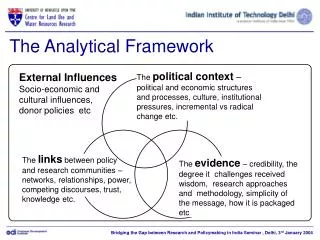
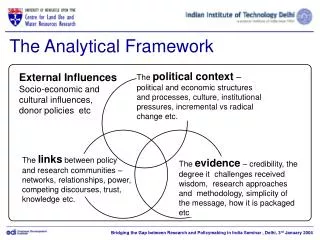
The political context – political and economic structures and processes, culture, institutional pressures, incremental vs radical change etc. The links between policy and research communities – networks, relationships, power, competing discourses, trust, knowledge etc. The evidence – credibility, the degree it challenges received wisdom, research approaches and methodology, simplicity of the message, how it is packaged etc The Analytical Framework External Influences Socio-economic and cultural influences, donor policies etc
The political context – political and economic structures and processes, culture, institutional pressures, incremental vs radical change etc. The links between policy and research communities – networks, relationships, power, competing discourses, trust, knowledge etc. The evidence – credibility, the degree it challenges received wisdom, research approaches and methodology, simplicity of the message, how it is packaged etc The Analytical Framework External Influences Socio-economic and cultural influences, donor policies etc
External Influences A Practical Framework political context Politics and Policymaking Campaigning, Lobbying Policy analysis, & research Media, Advertising, Networking Scientific information exchange & validation Research, learning & thinking evidence links
Using the framework • The external environment: Who are the key actors? What is their agenda? How do they influence the political context? • The political context: Is there political interest in change? Is there room for manoeuvre? How do they perceive the problem? • The evidence: Is it there? Is it relevant? Is it practically useful? Are the concepts familiar or new? Does it need re-packaging? • Links: Who are the key individuals? Are there existing networks to use? How best to transfer the information? The media? Campaigns?
Putting it into practice • Work with them – seek commissions • Strategic opportunism – prepare for known events + resources for others • Get to know the policymakers. • Identify friends and foes. • Prepare for policy opportunities. • Look out for policy windows. • Who are the policymakers? • Is there demand for ideas? • What is the policy process? • Establish credibility • Provide practical solutions • Establish legitimacy. • Present clear options • Use familiar narratives. • Build a reputation • Action-research • Pilot projects to generate legitimacy • Good communication • What is the current theory? • What are the narratives? • How divergent is it? • Build partnerships. • Identify key networkers, mavens and salesmen. • Use informal contacts • Get to know the others • Work through existing networks. • Build coalitions. • Build new policy networks. • Who are the stakeholders? • What networks exist? • Who are the connectors, mavens and salesmen?
Paravets in Kenya 1970s 1980s 1990s 2000s • Professionalisation of Public Services. • Structural Adjustment → collapse. • Paravet projects emerge. • ITDG projects. • Privatisation. • ITDG Paravet network. • Rapid spread in North. • KVB letter (January 1998). • Multistakeholder WSs → new policies. • Still not approved / passed!
Paravets in Kenya - political context 1970s 1980s 1990s 2000s • Professionalisation of Public Services. • Structural Adjustment → collapse of services. • Paravet projects emerge. • ITDG projects. • Privatisation. • ITDG Paravet network. • Rapid spread in North. • KVB letter (January 1998). • Multistakeholder WSs → new policies. • Still not approved / passed! • Professionalisation of Public Services. • Structural Adjustment • Privatisation and change of DVS. • ITDG Paravet network and change of DVS. • KVB letter (January 1998). • Multistakeholder WSs→ new policies.
Paravets in Kenya - Research International Research 1970s 1980s 1990s 2000s • Professionalisation of Public Services. • Structural Adjustment → collapse of services. • Paravet projects emerge. • ITDG projects. • Privatisation. • ITDG Paravet network. • Rapid spread in North. • KVB letter (January 1998). • Multistakeholder WSs → new policies. • Still not approved / passed! • Professionalisation of Public Services. • Structural Adjustment • Privatisation and change of DVS. • ITDG Paravet network and change of DVS. • KVB letter (January 1998). • Multistakeholder WSs→new policies. ITDG projects – collaborative action research. The Hubl Study
DELIVERI Project - Indonesia • 5-year DFID-funded programme to make livestock service more responsive to the needs of the poor • Action-research. 5 components: • Pilot projects • Institutional Development • HRD • Total Quality Management • Information & influence • Astonishingly successful – why?
Success factors • Designed for policy influence – at the right time. • Approach – participatory action-research, with all stakeholders. • Marketing / Communication strategy. • Luck – economic crisis caused a poliitical crisis. • Ready to seize the policy window. • Flexible, opportunistic.
Other sources of information: http://www.odi.org.uk/rapid