Download
1 / 1
10 likes | 128 Views
Isaac Newton observed that apples fall towards the Earth, leading him to ponder whether all celestial bodies are similarly governed by a universal force. His hypothesis enabled him to predict planetary motions accurately, confirmed by astronomers' measurements. In studying the scientific method, we recognize three initial steps: Observation (O), where phenomena are noted; Hypothesis (H), proposing potential explanations; and Experimentation (E), testing those explanations. Newton's conclusion suggests that a universal gravitational force governs both terrestrial and celestial objects, revolutionizing our understanding of the universe.

E N D
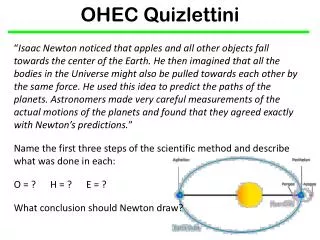
OHEC Quizlettini “Isaac Newton noticed that apples and all other objects fall towards the center of the Earth. He then imagined that all the bodies in the Universe might also be pulled towards each other by the same force. He used this idea to predict the paths of the planets. Astronomers made very careful measurements of the actual motions of the planets and found that they agreed exactly with Newton’s predictions.” Name the first three steps of the scientific method and describe what was done in each: O = ? H = ? E = ? What conclusion should Newton draw?