Download
1 / 16
160 likes | 261 Views
Explore Pulse Shape Analysis (PSA) with a segmented Germanium detector, distinguishing between single-site and multi-site events to enhance signal identification and background rejection. Use pulse properties and analysis procedure to delve into energy deposit locations with pulse shapes. The procedure involves training PSA packages, collecting SSE and MSE samples, and applying the PSA package to distinguish signal and background events. Collaborate with Majorana MC group to understand pulse shape simulation and enhance identification of photon and surface background while improving signal efficiency.

E N D
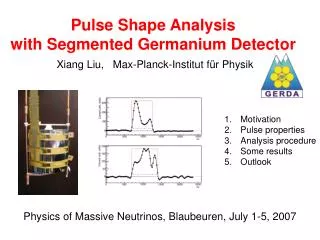
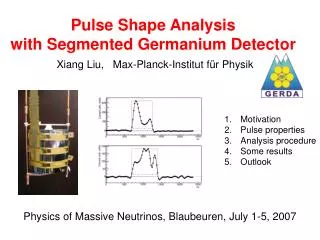
Pulse Shape Analysis with Segmented Germanium Detector Xiang Liu, Max-Planck-Institut für Physik • Motivation • Pulse properties • Analysis procedure • Some results • Outlook Physics of Massive Neutrinos, Blaubeuren, July 1-5, 2007
Motivation: Single-site vs. Multi-site Range log(R [mm]) SSE MSE 208Tl 2614keV photon (Geant4 simulation) NIM A 570 (2007) 479-486 Photon: Compton scattering multiple energy deposits 02: energy deposit locally, within 1mm. 02: 2 electrons Blaubeuren, July 1-5, 2007 Page 2
Motivation: 3-D segmentation along z, & r GERDA Phase-II prototype detector: 18 segments (3 fold along z, 6 along ) No segment along r, technical difficulty Solution Pulse Shape Analysis (PSA) Electrons & holes drift along the applied field at ~1cm/100ns, inducing charge in electrodes. Rise part of pulse contains information about energy deposit locations. Blaubeuren, July 1-5, 2007 Page 3
Pulse shape properties Single site event (SSE): Knee indicates that one charge carrier reaches electrode and stops drifting Multiple site event (MSE): MSE tends to have more complicated pulse structures. Blaubeuren, July 1-5, 2007 Page 4
Pulse shape analysis procedure SSE candidate MSE candidate Test stand with 18-fold Ge detector PSA procedure: Collect SSE and MSE samples, independent of pulse shapes. Study the PS difference, train PSA package. Apply the trained PSA package to identify signal and background. Blaubeuren, July 1-5, 2007 Page 5
Collecting SSE sample: • Double escape events (DEP): • one electron and one positron • with sum energy 1592keV 2614keV • Single Compton scattering events: • single electron • with energy 2039keV Blaubeuren, July 1-5, 2007 Page 6
Pulse shape analysis packages Likelihood method: pulse rise time current FWHM Neural Network method: sampled pulses as input Define discriminator Blaubeuren, July 1-5, 2007 Page 7
Neural Network PSA results DEP 1592keV Bi-212 1620keV Single segment events Blaubeuren, July 1-5, 2007 Page 8
Outlook1: Pulse shape simulation • Need simulation to understand: • energy deposit range pulse shape • Understand second order effect: • charge carrier drifting velocity • depends on crystal axis, • impurity concentration • & non-uniformity, • trapping, • preamplifier bandwidth, • … • Close collaboration with • Majorana MC group NIM doi:10.1016/j.nima.2007.03.035 [Nucl-ex/0701004] Blaubeuren, July 1-5, 2007 Page 9
Outlook2: New test stand under construction • Both Ge detector and source in Vacuum: • photon • • UV laser • • 3-D scan of the detector. Blaubeuren, July 1-5, 2007 Page 10
Outlook3: application example: Mirror charge • Mirror charge from neighboring segments gives additional information along z & . • enhance MSE identification • identify signal at segment boundaries • identify surface contamination () z phi Mirror charge amplified by factor of 4 Blaubeuren, July 1-5, 2007 Page 11
Conclusion Measurement with 18-fold Ge detector proves the technique and its ability for background identification. NIM doi:10.1016/j.nima.2007.03.035 [nucl-ex/0701004], nucl-ex/0701005 First analysis proves that properly-trained pulse shape analysis package identifies most multi-site background events. arXiv:0704.3016 A new test stand is under construction at MPI Munich, where segmented Ge detector will be studied in detail with , , e sources and UV laser. With detailed simulation and mirror charge, PSA is expected to further identify photon and surface backgrounds improve signal efficiency Blaubeuren, July 1-5, 2007 Page 12
Backup2: NN PSA results with DEP, continued Fraction of SSE (MSE) as correctly identified by NN as SSE (MSE): Blaubeuren, July 1-5, 2007 Page 13
Backup1: NN PSA results with DEP Fraction of SSE: Fraction identified by NN as SSE: Blaubeuren, July 1-5, 2007 Page 14
Backup2: Pulse shape analysis packages Blaubeuren, July 1-5, 2007 Page 15
Backup3: Mirror charge Mirror charge asymmetry of neighbor segments: NIM doi:10.1016/j.nima.2007.03.035 [Nucl-ex/0701004] Blaubeuren, July 1-5, 2007 Page 16