
Understanding Psoriasis: A Chronic Skin Disease Explained
E N D
Presentation Transcript
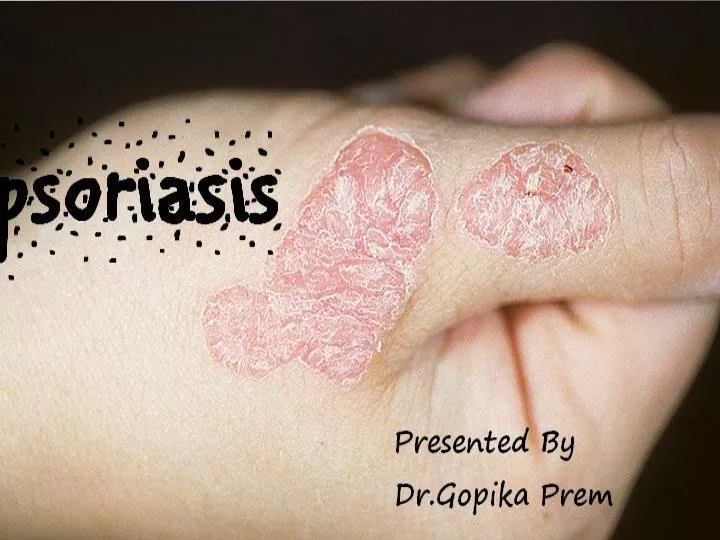
Definition * Chronic papulosqamous disease of unknown etiology characterised by multiple erythematous papules & plaques with micaceous scales mainly involving extensor aspect of legs,elbows,lower buttocks,scalp due to accelerated epidermopoiesis In simple words, * A Chronic (longlasting) skin disease characterized by scaling and inflammation. Scaling occurs when cells in the outer layer of skin reproduce faster than normal and pile upon the skin’s surface
Etiology • Genetic factors • - Autosomal dominant with incomplete penetrance. • - Increased prevalence of HLACw6. • - 9 locations on different chromosomes that are associated wit psoriasis. • Major determinant is PSORS1,which is located on chromosome 9 in MHC.3genes in PSORS1 locus have a strong association with psoriasis vulgaris. • Environmental factors
Who is infected? • About 1 to 2% of the U.S population or 5.5 million people get infected. • Mostly common between the age 15 to 35 years old. • Mostly frequently occurs are male Caucasians population. • It is also inherited
Triggering Factors * Stress * Alcohol * Drugs - AntiHT(beta blockers) - Lithium - Antimalarials(chloroquine) - NSAID's-(Aspirin,Ibuprofen) * Infection * Sunlight * Climate * Metabolic Factors like Pregnancy * Trauma & surgery
Clinical Picture • Predominantly affects extensor aspects of extremities & lumbosacral area of trunk • Erythematous papules and plaques wit white micaceous scales • Classically lesions demonstrate AUSPITZ sign • Method of doing this test is called GRATTAGE Test • +ve koebners phenomenon • Associated nail & joint involvement
Pathology • Skin -> 1.Epidermis • 2.Dermis • 3.Hypodermis • Skincells are created in the dermis and is moved to through the epidermis to the skin surface. • Process takes 28-30 days • In psoriasis patients hyperpoliferation takes place • Transit time is shortened to 4-5 days, thus scales appear in the skin
Types of Psoriasis • Psoriasis vulgaris • Guttate psoriasis • Palmoplander psoriasis • Flexular psoriasis • Psoriatic arthrcpathy • Erthrodermic psoriasis • Psoriasis of nails
Types of Psoriasis According to the site of involvement it is specified as • Scalp psoriasis • Palmoplantar psoriasis • Nail psoriasis • Acropustolosis
HPE • Hyperkeratosis • Parakeratosis • Acanthosis • Papillomatosis • Munromicroabscesses • Suprapapillary thinnin of epidermis
Diagnosis • Clinical Features - Primary Test • Grettage test - Diagnosis • Biopsy - Confirmation • How severe • 1. Mild -> affecting < 3% of skin • 2. Moderate -> affecting 3-10% of skin • 3. Severe -> depends on the following • Proportion of body surface affected • Disease activity • Response of previous therapies • Impact of disease on the person
Differential Diagnosis • Secondary Syphilis • Lichen Planus • Pityriasis Rubra Pilaris • Seborrheic Dermatitis
Types of Treatment Three types of treatment, also called 1-2-3 approach • Topical treatment • Systemic treatment • Photo therapy treatment
Type of Treatment Topical Treatment Coal tar application over lesions * Icthyol salicylic ointment-6%ichthyol+35%salicylic acid used. * Goeckermans regime - daily application of tar, UVR exposure Dithramol * 0.1 to 1 %conc used * ointment based anthralin applied to lesions n washed off after 30 min to 2hr application time
Type of Treatment Topical Treatment Calapotrial * It is a Vitamin d3 analogue * Effective 4 both short n long term treatment of psoriasis * Mainly used 4 resistant localized psoriatic patches * Highly expensive Tazarotene * 0.1% to 0.05%gel * Modified vitamin A molecule formulated as topical agent * Mainly used for treatment of nail psoriasis Topical steriods * Mild to moderate psoriasis * Clobetasol propionate,halobetasol used * Reduces the itching n redness
Type of Treatment Systemic treatment • Methotrescale • * Antometabolie,folic acid antagonist • * Inhibits mitosis • * Drug of choice in psoriatic arthropathy • * Dose : 7.5mg to 15mg/week • Puva Therapy • * Psoarlen,photosensitising agent • * Pro drug that upon oral administration is distributed through out the body,bt is only activated by UVR in those sites that are exposed to uva • * Taken on alternate days • * Puva sol-psoralen +exposure to sunlight • * Patient need to wear UVR resistant glasses for 24 hrs after therapy
Type of Treatment Systemic treatment • Oral retinoids • * Especially for pustular patients • * 0.5mg to 1mg/kg body wt • Cyclosporine • * Immunosuppressive • * Dose 2.5 to 5 mg/kg body wt per day • Biologicals • * Infliximab, etanercept • * Other drugs that can b used are hydroxy urea and sulfasalazine
Type of Treatment Systemic treatment • Hydroxyurea • Antibiotics • * Doxycycline • * Polymorphonuclear chemotaxis • Rotating treatment • * All modalities of Rx used for wide spread severe patients • * Have side effects when used for long time • * So switch the medicine in 1-2 years
Type of Treatment • Photo therapy treatment • UVB photo therapy • PUVA (ultraviolet A (UVA)
Course of the Disease • Psoriasis is a lifelong condition. • Many of the most effective agents used to treat severe psoriasis carry an increased risk of significant morbidity including skin cancers, lymphoma and liver disease. • Controlling the signs and symptoms typically requires lifelong therapy.