Download
1 / 46
460 likes | 571 Views
This document provides an in-depth exploration of the HTESSEL (Hydrology Temperature and Energy Scheme for Soil Evaporation and Land Surface) parameterization, focusing on the energy and water balance equations, soil hydrology, and surface tiling. It explains key components such as surface energy balance, evaporation processes, soil heat transfer mechanisms, and the interaction between vegetation and atmospheric factors. The parameterization includes a multi-layer scheme to account for dynamic and static tile fractions, enabling accurate modeling of land-atmosphere interactions critical for climate studies.

E N D
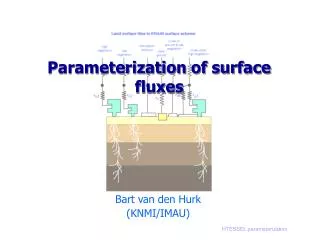
Parameterization of surface fluxes Bart van den Hurk (KNMI/IMAU) HTESSEL parameterization
General form of land surface schemes Q* H E PSN ESN Accumulation G M • Energy balance equation K(1 – a) + L – L + E + H = G • Water balance equation W/t = P – E – Rs – D S/t = Psn – Esn – M P E Rs Infiltration D HTESSEL parameterization
Soil hydrology • Top: F [kg/m2s] = T – Esoil – Rs + M • Bottom (free drainage) F = Rd = wK • with • T = throughfall (Pl – Eint – Wl/t) • Esoil = bare ground evaporation • Eint = evaporation from interception reservoir • Rs = surface runoff • Rd = deep runoff (drainage) • M = snow melt • Pl = liquid precipitation • Wl = interception reservoir depth • S = root extraction Pl Eint T Wl Esoil M Rs S Rd HTESSEL parameterization
Soil heat flux • Multi-layer scheme • Solution of diffusion equation • with • C [J/m3K] = volumetric heat capacity • T [W/mK] = thermal diffusivity • with boundary conditions • G [W/m2] at top • zero flux at bottom HTESSEL parameterization
Main sections • Surface tiling • Surface energy balance & vegetation • Soil heat transfer • Soil hydrology • Snow hydrology & albedo • Surface characteristics (“climate fields”) HTESSEL parameterization
Tile structure of HTESSEL • 6 fractions (“tiles”) • Aerodynamic coupling • Vegetatie • Verdampingsweerstand • Wortelzone • Neerslaginterceptie • Kale grond • Sneeuw HTESSEL parameterization
Tile structure of HTESSEL • 6 fractions (“tiles”) • Aerodynamic coupling • Wind speed • Roughness • Atmospheric stability • Vegetatie • Verdampingsweerstand • Wortelzone • Neerslaginterceptie • Kale grond • Sneeuw HTESSEL parameterization
Tile structure of HTESSEL • 6 fractions (“tiles”) • Aerodynamic coupling • Wind speed • Roughness • Atmospheric stability • Vegetation • Canopy resistance • Root zone • Interception • Kale grond • Sneeuw HTESSEL parameterization
Tile structure of HTESSEL • 6 fractions (“tiles”) • Aerodynamic coupling • Wind speed • Roughness • Atmospheric stability • Vegetation • Canopy resistance • Root zone • Interception • Bare ground • Sneeuw HTESSEL parameterization
Tile structure of HTESSEL • 6 fractions (“tiles”) • Aerodynamic coupling • Wind speed • Roughness • Atmospheric stability • Vegetation • Canopy resistance • Root zone • Interception • Bare ground • Snow HTESSEL parameterization
Tile fractions (calculated every time step) • 3 ‘static’ tiles • high vegetation • low vegetation • bare ground • 3 ‘dynamic’ tiles • interception reservoir • snow low/bare • snow forest HTESSEL parameterization
Parameterization of surface energy balance and evaporation HTESSEL parameterization
Aerodynamic exchange • Turbulent fluxes are parameterized as (for each tile): • Solution of CH requires iteration: • CH = f(L) • L = f(H) • H = f(CH) L = Monin-Obukhov length HTESSEL parameterization
Treatment of tiled evaporation • Potential evaporation (P): a = s = CHU = 1/raH • Transpiration (T) a = s = 1/(raH + rc) • Combined snow tile (S) T P T S T P HTESSEL parameterization
More on the canopy resistance • Active regulation of evaporation via stomatal aperture • Empirical (Jarvis-Stewart) approach: rc = (rc,min/LAI) f(K) f(D) f(W) HTESSEL parameterization
Jarvis-Stewart functions • Shortwave radiation: • Atmospheric humidity deficit (D): f3 = exp(-cD) (c 0 for forest only) HTESSEL parameterization
Jarvis-Stewart functions • Soil moisture ( = weighted mean liquid water over root profile): • Standard approach: linear profile 1 HTESSEL parameterization
Specification of vegetation types HTESSEL parameterization
Soil heat flux HTESSEL parameterization
Numerical solution • Solution of energy balance equation • With (all fluxes positive downward) • Express all components in terms of Tsk (with Tp = Tskt -1) netradiation sensible heat flux latent heat flux soil heat flux HTESSEL parameterization
Numerical solution • Substitute linear expressions of Tsk into energy balance equation • Sort all terms with Tsk on lhs of equation • Find Tsk = f(Tp , Tsoil , CH ,forcing, coefficients) HTESSEL parameterization
Soil heat transfer HTESSEL parameterization
Heat transport in soil • Multi-layer scheme • Solution of diffusion equation • with • C [J/m3K] = volumetric heat capacity • T [W/mK] = thermal diffusivity • with boundary conditions tiled soil heat flux direct absorption snow base heat flux HTESSEL parameterization
Heat capacity and thermal diffusivity • Heat capacity • sCs 2 MJ/m3K, wCw 4.2 MJ/m3K • Thermal diffusivity depends on soil moisture • dry: ~0.2 W/mK; wet: ~1.5 W/mK HTESSEL parameterization
Freezing of soil water • In case of melt/freezing, and extra heat capacity term is added: • The ice fraction is a diagnostic variable: fixed value, to decouple water and temperature eqs HTESSEL parameterization
Parameterization of soil hydrology HTESSEL parameterization
Soil water flow • Water flows when work is acting on it • gravity: W = mgz • acceleration: W = 0.5 mv2 • pressure gradient: W = m dp/ = mp/ • Fluid potential (mechanical energy / unit mass) • = gz + 0.5 v2 + p/ p = gz • g(z+z) = gh • h = /g = hydraulic head = energy / unit weight = • elevation head (z) + • velocity head (0.5 v2/g) + • pressure head ( = z = p/g) HTESSEL parameterization
Relation between pressure head and volumetric soil moisture content strong adhesy/ capillary forces dewatering from large to small pores retention curve HTESSEL parameterization
Darcy and Richards equation qz = flux HTESSEL parameterization
Darcy and Richards equation = vol. soil moisture content (m3/m3) K = hydraulic conductivity (m/s) D = hydraulic diffusivity (m2/s) HTESSEL parameterization
Implementation in discrete form • In (discrete) flux form: • With F specified as: root extraction diffusion term gravity term HTESSEL parameterization
Parameterization of K and D • 2 ‘schools’ • Clapp & Hornberger ea • single parameter (b) • Van Genuchten ea • more parameters describing curvature better • Defined ‘critical’ soil moisture content • wilting point ( @ = -150m or -15 bar) • field capacity ( @ = -3m or -0.33 bar) HTESSEL parameterization
Boundary conditions • Top: F [kg/m2s] = T – Esoil – Rs + M • Bottom (free drainage) F = Rd = wK • with • T = throughfall (Pl – Eint – Wl/t) • Esoil = bare ground evaporation • Eint = evaporation from interception reservoir • Rs = surface runoff • Rd = deep runoff (drainage) • M = snow melt • Pl = liquid precipitation • Wl = interception reservoir depth • S = root extraction Pl Eint T Wl Esoil M Rs S Rd HTESSEL parameterization
Parameterization of interception • Simple budget equation • with • El = evaporation • D = dew collection • I = interception from precipitation • Points for attention: • maximum storage reservoir ~ 0.2 mm per m2 leaf/ground area • rapid process (water conservation in discrete time step needs care) • interception efficiency depends on type of precipitation (large scale precip: very efficient. convective precip: more falls off) HTESSEL parameterization
Parameterization of runoff • Simple approach • Infiltration excess runoff Rs = max(0, T – Imax), Imax = K() • Difficult to generate surface runoff with large grid boxes • Explicit treatment of surface runoff • ‘Arno’ scheme Infiltration curve (dep on W and orograpy) Surface runoff HTESSEL parameterization
Parameterization of snow HTESSEL parameterization
Snow parameterization • Effects of snow • energy reflector • water reservoir acting as buffer • thermal insolator • Parameterization of albedo • open vegetation/bare ground • fresh snow: albedo reset to amax (0.85) • non-melting conditions: linear decrease (0.008 day-1) • melting conditions: exponential decay • (amin = 0.5, f = 0.24) • For tall vegetation: snow is under canopy • gridbox mean albedo = fixed at 0.2 HTESSEL parameterization
Parameterization of snow water • Simple approach • single reservoir • with • F = snow fall • E, M = evap, melt • csn = grid box fraction with snow • Snow depth • with • sn evolving snow density (between 100 and 350 kg/m3) HTESSEL parameterization
Snow energy budget • with • (C)sn = heat capacity of snow • (C)i = heat capacity of ice • GsnB = basal heat flux (T/rs) • Qsn = phase change due to melting (dependent on Tsn) HTESSEL parameterization
Snow melt • Is energy used to warm the snow or to melt it? In some stage (Tsn 0C) it’s both! • Split time step into warming part and melting part • first bring Tsn to 0C, and compute how much energy is needed • if more energy available: melting occurs • if more energy is available than there is snow to melt: rest of energy goes into soil. HTESSEL parameterization
Surface characteristics(surface ‘climate fields’) HTESSEL parameterization
Surface climate fields • Vegetation types • Vegetation cover • Surface geopotential • Land/sea mask • oro (for runoff and for z0m(orographic part) • vegetation roughness z0m • thermal roughness z0h • monthy background (snowfree) albedo • Soil type (for hydraulic properties) HTESSEL parameterization
Vegetation distribution HTESSEL parameterization
Climatological albedo (static vegetation) Jan Jul HTESSEL parameterization
Prognostic quantities • 4 soil temperatures • 4 soil moisture contents • interception reservoir depth • snow depth • snow albedo • snow density • snow temperature • (skin temperature) (adjusts rapidly) HTESSEL parameterization
More information • Bart van den Hurk • hurkvd@knmi.nl HTESSEL parameterization