Understanding the Polygon Angle-Sum Theorem and Classifying Polygons
Dive into the essentials of the Polygon Angle-Sum Theorem and learn to calculate the angles of quadrilateral ABCD. This guide covers the nature of polygons, including definitions of convex and concave shapes, and provides step-by-step instructions for identifying vertices, sides, and angles. Additionally, explore the sum of internal and external angles for various polygons with clear examples. Complete exercises and tables to enhance your polygon classification skills. Perfect for students looking to reinforce their understanding of geometric principles!

Understanding the Polygon Angle-Sum Theorem and Classifying Polygons
E N D
Presentation Transcript
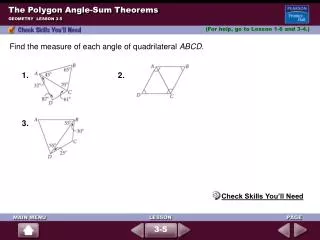
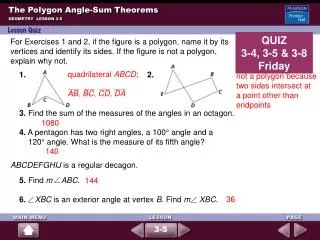
Check Skills You’ll Need Find the measure of each angle of quadrilateral ABCD. 32 45 30 55 65 70 25 87 61 55
Classifying Polygon A polygon is a closed plane figure with at least three sides that are segments. The sides intersect only at their endpoints, and no adjacent sides are collinear.
Name the polygon. Then Identify its vertices, sides , and angles. D H B K G M
A CONVEX polygon has no diagonal with points outside the polygon. A CONCAVE polygon has at least one diagonal with points outside the polygon
Theorem 3 – 9 Polygon Angle-Sum Theorem The sum of the measures of the angles of an n-gon is (n – 2)180.
Theorem 3 – 10 The sum of the measures of the exterior angles of a polygon, one at each vertex , 360. For the pentagon, m/_ 1 + m/_ 2 + m /_ 3 + m /_ 4 + m /_ 5 = 360 3 2 4 1 5
The game board whose figure is shown has the shape of a regular hexagon. It is packaged in a rectangular box outlined beneath it. The box uses four right triangles made of foam in its four corners. Find m/_ 1 in each foam triangle 2 2 1 1 1 1 2 2