Our Founding Principles Class 3
This class explores the founding principles of American governance, emphasizing Natural Law and its crucial role in the creation of the Constitution. We'll discuss the distinctions between democracy and a republic, delve into the implementation of Natural Law, and analyze influential quotes from the Founding Fathers. By engaging in interactive discussions, students will learn to identify facts, distinguish belief from truth, and engage in meaningful dialogue about the values that underpin our system of government. Join us as we review essential tenets such as unalienable rights and duties, limited government, and the importance of checks and balances.

Our Founding Principles Class 3
E N D
Presentation Transcript
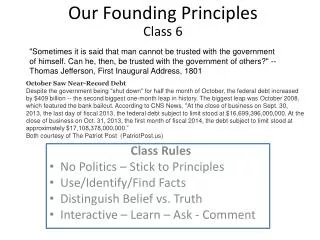
Our Founding PrinciplesClass 3 • Class Rules • No Politics – Stick to Principles • Use/Identify/Find Facts • Distinguish Belief vs. Truth • Interactive – Learn – Ask - Comment
Class 3 Agenda Review www.freedom101.us site wrt Class Posts Finish Democracy vs. Republic Discussion Discuss Creation of the Constitution Founder’s Quotes about Constitution Break Natural Law Presentation Discuss How Natural Law Was Implemented Quotes about Natural Law Federalism – If we get that far! Info posted at: www.freedom101.us/category/TELOS1/
Freedom 0% 100% Anarchy Democratic Autocratic Republic Natural Law Majority Citizens Government Citizens Citizens F. Constitution Government F. Government Citizens Minority Citizens S. Constitution S. Government L. Government
Freedom 0% 100% Anarchy Democratic Autocratic Republic Natural Law Majority Citizens Government Citizens Citizens F. Constitution Government F. Government Citizens Minority Citizens S. Constitution S. Government L. Government
Freedom 0% 100% Anarchy Autocratic Democratic Majority Citizens Government Minority Citizens Votes Tax Law $
Freedom 0% 100% Anarchy Democratic Autocratic Republic Natural Law Majority Citizens Government Citizens Citizens F. Constitution Government F. Government Citizens Minority Citizens S. Constitution S. Government L. Government
Freedom 0% 100% Anarchy Democratic Autocratic Republic Natural Law Majority Citizens Government Citizens Citizens F. Constitution Government F. Government Citizens Minority Citizens S. Constitution S. Government L. Government
Courtesy of Constitutional Rights Foundation, for BC distribution to students & staff only.c
Courtesy of Constitutional Rights Foundation, for BC distribution to students & staff only.c
Courtesy of Constitutional Rights Foundation, for BC distribution to students & staff only.c
Courtesy of Constitutional Rights Foundation, for BC distribution to students & staff only.c
Courtesy of Constitutional Rights Foundation, for BC distribution to students & staff only.c
Courtesy of Constitutional Rights Foundation, for BC distribution to students & staff only.c
Courtesy of Constitutional Rights Foundation, for BC distribution to students & staff only.c
Courtesy of Constitutional Rights Foundation, for BC distribution to students & staff only.c
Courtesy of Constitutional Rights Foundation, for BC distribution to students & staff only.c
Courtesy of Constitutional Rights Foundation, for BC distribution to students & staff only.c
Courtesy of Constitutional Rights Foundation, for BC distribution to students & staff only.c
Courtesy of Constitutional Rights Foundation, for BC distribution to students & staff only.c
Courtesy of Constitutional Rights Foundation, for BC distribution to students & staff only.c
Courtesy of Constitutional Rights Foundation, for BC distribution to students & staff only.c
Courtesy of Constitutional Rights Foundation, for BC distribution to students & staff only.c
Natural Law • What it is • How it was implemented • Quotes re Natural Law
Natural Law & our Constitution • Unalienable rights including: • Right to self government, • Right to bear arms, • Right to own, develop and dispose of property, • The right to assemble, • The right to petition, • The right of free speech & press • The right to enjoy the fruits of one’s labors, • The right to contrive and invent, • The right to privacy, • The right to provide personal security, • The right to a fair trial, • The right of free association, • The right to contract. • Unalienable Duties, including: • To not take the life of another except in self-defense, • To not steal or destroy the property of another, • To be honest in all transactions with others, • For parents and to protect, teach, feed, clothe & shelter children, • To support law and order and keep the peace, • To help the helpless, • To maintain the integrity of the family structure, • To perpetuate humanity, • To not promote or participate in the vices which destroy personal and community life, • To follow rules of moral rectitude. • Habeas corpus • Limited government • Separation of powers • Checks and balances • Justice by reparation or paying of damages • No Taxation without Representation • Justice System