Transitioning from Robotic Prostatectomy to Partial Nephrectomy: A Skills Transfer Study
10 likes | 125 Views
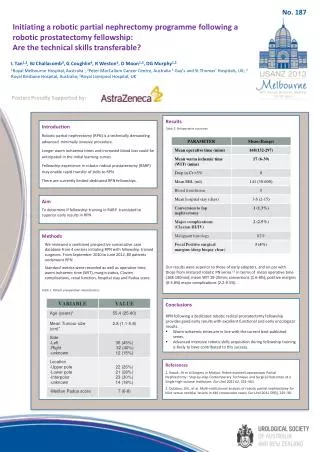
This study evaluates the transferability of surgical skills from robotic radical prostatectomy (RARP) to robotic partial nephrectomy (RPN) following a dedicated fellowship. By analyzing 80 RPN cases from four centers, we found that fellowship-trained surgeons achieved superior perioperative outcomes, including mean operative and warm ischemic times comparable to established robotic RPN series. Our results indicate that advanced skills acquired during RARP training contribute to the success of RPN, with promising functional and oncological results in early patient outcomes.


Transitioning from Robotic Prostatectomy to Partial Nephrectomy: A Skills Transfer Study
E N D
Presentation Transcript
No. 187 Initiating a robotic partial nephrectomy programme following a robotic prostatectomy fellowship: Are the technical skills transferable? L Tan1,2, BJ Challacomb3, G Coughlin4, R Weston5, D Moon1,2, DG Murphy1,2 1Royal Melbourne Hospital, Australia ; 2Peter MacCallum Cancer Centre, Australia 3 Guy’s and St Thomas’ Hospitals, UK; 4 Royal Brisbane Hospital, Australia; 5Royal Liverpool Hospital, UK Posters Proudly Supported by: • Results • Table 2. Perioperative outcomes • Our results were superior to those of early adopters, and on par with those from matured robotic PN series1-2 in terms of mean operative time (168-190min); mean WIT 19-20min; conversions (1.6-6%); positive margins (0-3.8%) major complications (2.2-9.5%). • RPN following a dedicated robotic radical prostatectomy fellowship provides good early results with excellent functional and early oncological results. • Warm ischaemic times are in line with the current best published series. • Advanced intensive robotic skills acquisition during fellowship training is likely to have contributed to this success. • . Introduction Robotic partial nephrectomy (RPN) is a technically demanding advanced minimally invasive procedure. Longer warm ischaemia times and increased blood loss could be anticipated in the initial learning curves Fellowship experience in robotic radical prostatectomy (RARP) may enable rapid transfer of skills to RPN. There are currently limited dedicated RPN fellowships. . Aim To determine if fellowship training in RARP translated to superior early results in RPN Methods We reviewed a combined prospective consecutive case database from 4 centres initiating RPN with fellowship trained surgeons. From September 2010 to June 2012, 80 patients underwent RPN Standard metrics were recorded as well as operative time, warm ischaemic time (WIT), margin status, Clavien complications, renal function, hospital stay and Padua score. Table 1. Patient preoperative characteristics Conclusions References 1. Kaouk, JH et al.Surgery in Motion: Robot-assisted Laparoscopic Partial Nephrectomy : Step-by-step Contemporary Technique and Surgical Outcomes at a Single High-volume Institution. EurUrol 201262, 553–561. 2. Dulabon, LM., et al. Multi-institutional analysis of robotic partial nephrectomy for hilar versus nonhilar lesions in 446 consecutive cases. EurUrol 201159(3), 325–30.