Understanding Rocks: Types, Formation, and Classification
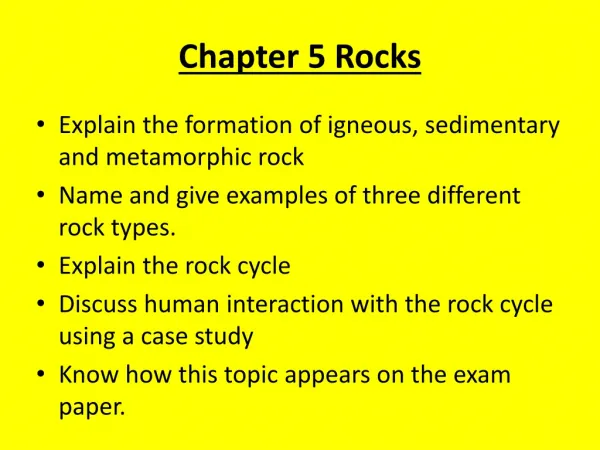
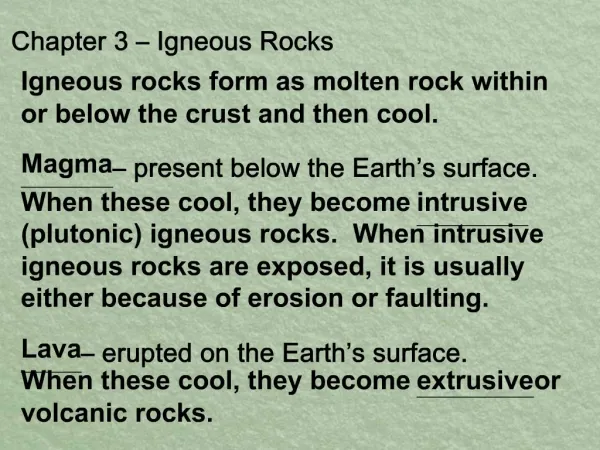
This chapter explores the three main classes of rocks: igneous, metamorphic, and sedimentary. Learn how cooling, hardening, weathering, and erosion transform rocks into sediments and metamorphic rocks. Discover the unique properties of igneous rocks, including their formation from magma and the role of minerals like mica and feldspar. Understand the rock cycle and the processes that classify rocks. Key concepts include the definition of sedimentary rocks, the importance of heat and pressure in rock transformation, and the characteristics of different rock types.


Understanding Rocks: Types, Formation, and Classification
E N D
Presentation Transcript
Chapter 3 - Rocks Test Wednesday
Which of following is not one of the three classes of rocks? • Igneous • Metamorphic • Magma
What two processes change rock into sediments? • Cooling & Hardening • Heat & Pressure • Weathering & Erosion
What two things can change sedimentary and igneous rocks into metamorphic rocks? • Cooling & Hardening • Heat & Pressure • Weathering & Erosion
What is the only kind of rock that can form directly from magma? • Igneous • Metamorphic • Sedimentary
All rocks are made up of • Lava • Sediments • Magma • Minerals
The grouping of things that are alike is the science of • Petrology • Classification • Geology • Biology
Rocks formed when melted minerals cool and harden are classified as • Molten rocks • Sedimentary rocks • Igneous Rocks • Lava Rocks
Magma that reaches Earth’s surface is called • Lava • Molten • Igneous • Conglomerate
Molten rock is made up of • Melted minerals • Lava • Obsidian • Iron and Nickel
The mineral crystals of a rock formed from magma usually are • Small • Large • Fine • Cubic
Rocks formed from the remains of living things are classified as • Metamorphic • Igneous • Sedimentary • Lava
Limestone and halite are examples of • Clastics • Nonclastics • Foliated • Nonfoliated
A rock formed when another rock is changed by heat and pressure is classified as • Metamorphic • Igneous • Sediment • Clastic
The series of natural processes by which rocks are slowly changed from one type to another is • Sedimentation • The Rock Cycle • Classification • Petrology
A metamorphic rock that has mineral crystals arranged in bands is • Unfoliated • Foliated • Clastic • Nonclastic
The texture of an igneous rock that does NOT have mineral crystals is • Fine • Clastic • Glassy • Foliated
Quartzite is formed from • Halite • Sandstone • Shale • Pyrite
Coal is a sedimentary rock formed from • Lava • Plants • Chemicals • Magma
Two minerals commonly found in igneous rocks are mica and • Halite • Feldspar • Pyrite • Silver