
Exchange of Best Practices on Integration: Programa Escolhas (Choices Programme) Overview
E N D
Presentation Transcript
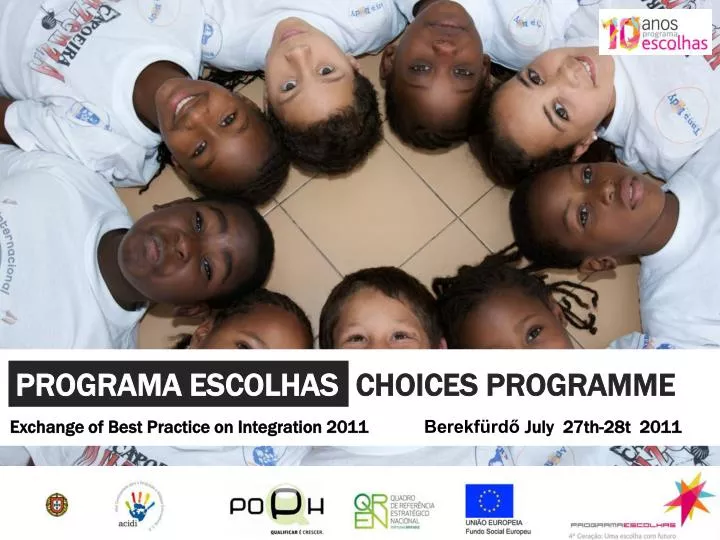
PROGRAMA ESCOLHAS CHOICES PROGRAMME Exchange of Best Practice on Integration 2011 BerekfürdőJuly 27th-28t 2011
Introduction • Nationalprogrammethatfunds, supports and evaluates 132 projects throughout the country (71 municipalities); • Existssince 2001: 10th anniversary; • Nowon 4th Generation: 2010-2012; • Governmentalprogramme • Integrated in the High Commission for Immigration and Intercultural Dialogue (ACIDI, IP); • Model of intervention based in “bottom-up” approach; • Funded by national budget (ISS, IEFP, ESF) and european funds that enhances the local resources.
“Programa Escolhas (Choices Programme) aims to support the social inclusion of children and young people from the most socio-economically disadvantaged contexts, looking for equal opportunities and social cohesion.”
Guidelines • Most vulnerable groups/communities; • Immigrant descendants and ethnical minorities, with a non-exclusive priority; • Locally designed projects; • Projectslocallymanagedbypartnerships (min. 3 institutions). • Skilled, multidisciplinary and flexible staff; • Whole approach with co-responsabilization of the Civil Society • Community Engagers; • Outreach • Multidimensional and integrated – 5 Axes;
IEducational Inclusion and non-formal education • Schoolreintegration • Creation and implementation of specific educational responses; • Dropout prevention; • Non-formal education; • Familyinvolvement.
IIVocational training and employability • Giving information and helping the integration in the labor market; • Creating and implementing vocational training and employment opportunities; • Promoting employment and internship based on corporate social responsibility.
IIICivic and community participation • Recreational and educational; • Artistic, sportiveand cultural activities; • Visitsandcontactswithcommunityorganizations; • Awarenessraisingandcommunitymobilization.
CID@NET Freeaccess 6 Networkedcomputers + Multifunction IVDigital inclusion 2 Cameras (videoandphoto) Broadband Internet • Occupational activities; • Information and Communication Technologies (ICT) workshops; • Certified trainings on ICT; • Promotion of school success and employability skills. Full-timetrainer
VEntrepreneurship and empowerment • Skills development activities; • Encouragement and financial support of projects planned, implemented and evaluated by young people; • Promotion of youth group creation, fostering grassroots initiatives; • Visits, internships and partnerships with other civil society organizations.
EvaluationandSupport • Support , evaluate and monitoring at distance by Internet (e-mail; web-basedplatformcalled AGIL); • Regular local visits to accompany some activities and give some support; • Analysis and evaluation of the projects six-months report; • Evaluation meetings with local consortiums; • Financial audits.
Mediation Evaluation Strategical Planning Participation Intercultural Dialogue Social Innovation Partnership
More datails: www.programaescolhas.pt ruid@programaescolhas.pt Thankyou for yourattention!