Estimating Spring Chinook Escapement in the Klickitat River Using DIDSON Sonar Technology
This study examines the adult escapement of spring Chinook salmon to the upper basin of the Klickitat River using DIDSON sonar counts in 2009. With the renovation of the Castile Falls Fishway in 2002-2005, access to 72 km of spawning habitat was restored, prompting a need for reliable monitoring of Chinook populations. The research highlights challenges in estimating escapement based on redd counts and discusses utilizing DIDSON technology to improve accuracy in counting fish passage, especially under adverse conditions. An overall escapement estimate for the year was calculated.

Estimating Spring Chinook Escapement in the Klickitat River Using DIDSON Sonar Technology
E N D
Presentation Transcript
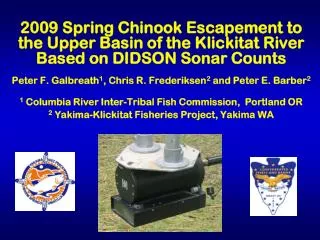
2009 Spring Chinook Escapement to the Upper Basin of the Klickitat River Based on DIDSON Sonar CountsPeter F. Galbreath1, Chris R. Frederiksen2 and Peter E. Barber21 Columbia River Inter-Tribal Fish Commission, Portland OR2 Yakima-Klickitat Fisheries Project, Yakima WA
Introduction 2002-2005 - Yakama Nation (YN) renovated Castile Falls (CF) Fishway (rkm 103) in Klickitat River gorge Renovations reopened anadromous salmon passage to upper basin Upper basin - 72 km of what could be prime spring Chinook and steelhead spawning and juvenile rearing habitat YN operate a spring Chinook integrated hatchery program below CF; currently only natural recolonization occurring above CF Need to monitor adult escapement
X X X
Introduction Currently, annual escapement of spring Chinook above CF estimated based on expanded redd count However, uncertainty exists due to: 1) difficulty in obtaining a definitive count of all redds, and 2) use of an average fish-per-redd expansion factor derived from Yakima and Klickitat River data An optical video direct-counting system planned for the Fishway (2011) In the meantime, proposed use of a DIDSON sonar for direct counting
Escapement Estimation with a DIDSON “Dual Identification Sonar”Sound Metrics Corp., Seattle WA “acoustic video camera” – can count fish in absence of trap at weir/dam Simultaneously emits sets of sound waves: Processes the echoes into electronic video files
Escapement Estimation with a DIDSON Placed to transmit horizontally across river, provides a top-down of view of the “ensonified” field (29° horizontally, 14° vertically) Provides images (low resolution) of fish when/where optical video cannot (darkness, turbidity) and at (much) greater distances
2009 Escapement Estimate files read from June 10 to Sept 10 Number of observed fish passage events = 18 (July 12 to August 22) data too sparse – no obvious diurnal pattern But, files missing for 10+ days within 42 day migration period Expansion for missing data = 6 ±4 fish Total escapement estimate = 24 ±4
2009 Klickitat River Flow (USGS gauge 1 km upstream of CF) and DIDSON Operation
2009 Escapement Estimate Redd count-based escapement estimate: redd count = 4 expansion factor = 3 fish per redd total escapement = 12 If DIDSON estimate of 24 ≈ “true”, redd count-based estimate too low, because: redd count (4) underestimated – redds not observed within surveyed area, and/or not all spawning area surveyed. the 3 fish per redd expansion factor underestimated due to pre-spawn mortality - from natural causes and/or from poaching