Download
1 / 12
120 likes | 241 Views
This quiz focuses on evaluating common and natural logarithms using both calculators and manual methods. You will learn how to solve logarithmic and exponential equations by applying equivalent equations. Explore the transformations of logarithmic functions, understand their graphs, and identify key characteristics such as asymptotes and domains. This material is essential for disciplines such as astronomy, chemistry, physics, and engineering, emphasizing the significance of logarithmic functions in scientific applications.

E N D
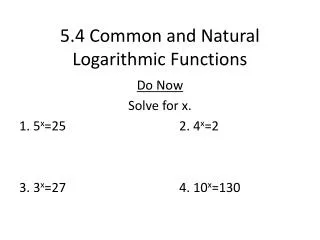
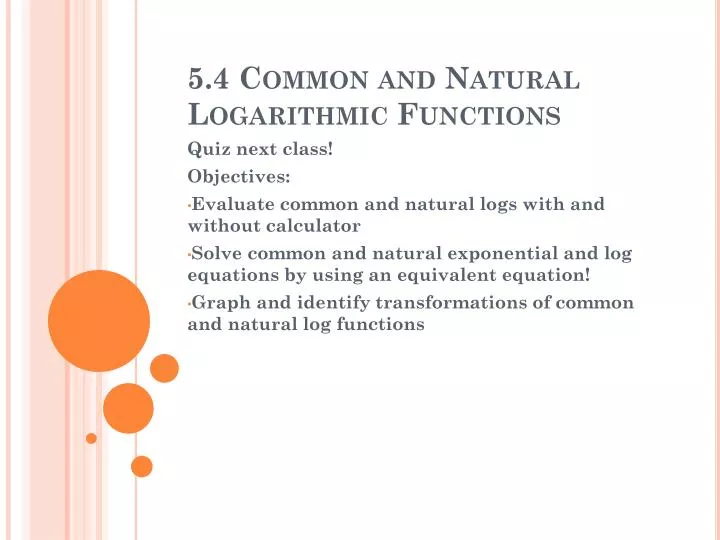
5.4 Common and Natural Logarithmic Functions Quiz next class! Objectives: Evaluate common and natural logs with and without calculator Solve common and natural exponential and log equations by using an equivalent equation! Graph and identify transformations of common and natural log functions
Before Calculators We had Logs! • Very useful for astronomy, chemistry, physics, and engineering • Still important for sciences and engineering • Today: Two most important types of logs • Base 10 and Base e.
Logarithms are Special Exponents Example 1: Evaluating Common Logarithms
Example 2: using Equivalent Statements Can be helpful:
Example 3: Evaluating Natural Logarithms: Ln Qu: How can we check to see if we did the calculations right?
Example 4: Solving by Using an Equivalent Statement Qu: Do you see a statement?
Graphs of Logarithmic Functions • Think of all the graphs of the different exponential functions: • The graphs of logarithmic functions have common characteristics also. What is the asymptote for each graph? Why is the domain of an exp. fn. the range of its corresponding log fn?
Example 7: Solving Logarithmic Equations Graphically Understand the graph! What does the x and y values represent What is the input and output
5.4 Hmwr; p. 361: 1,3, 7-13odd, 23-37odd, 43-49odd, 67Study for Quiz 5.1/5.2/5.4