Understanding Bohr's Model of the Hydrogen Atom and Electron Configurations
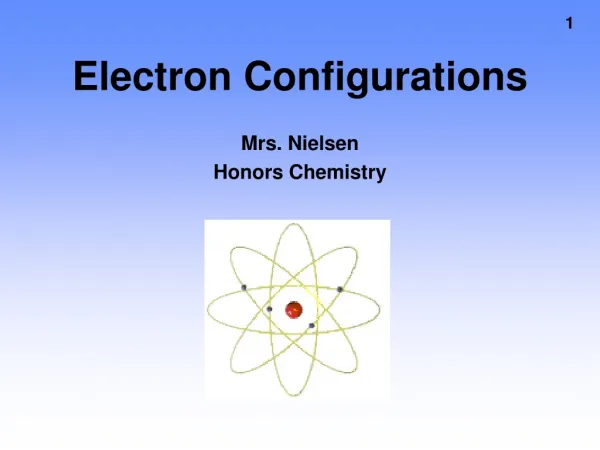
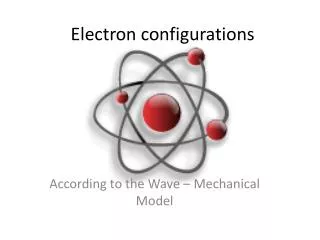
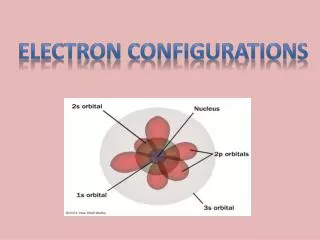
This lesson explores the concept of electron configurations and Niels Bohr's model of the hydrogen atom. We discuss the unique electromagnetic radiations emitted or absorbed by atoms, which indicate specific energy changes and reveal that these changes originate from the electron movements around the nucleus. The classic model's limitations are highlighted, paving the way to understanding quantized energy levels in atoms. Key terms such as ground state, excited state, and quantum are defined, emphasizing the fixed orbits of electrons and their corresponding energy levels.

Understanding Bohr's Model of the Hydrogen Atom and Electron Configurations
E N D
Presentation Transcript
Unit 3 Electron configurations Part B Bohr’s Model of Hydrogen
Discharging Tubes What have we learned so far? The Flame Test The light coming out of the excited atomic entities is very specific to particular element! Results are quite reproducible.
Electromagnetic radiations (lights) coming out or being absorbed by atoms indicate that there are very specific energy changes within the atomic entities (atoms and ions). No nuclear changes have ever been observed indicate that the energy changes have to come from electrons surrounding the nucleus.
How Come? Classic Model: Electron anywhere it ‘wants’ to be Problems with classic model: E moving through electric field will emit light & from the classic model, emitted light should have differing wavelengths
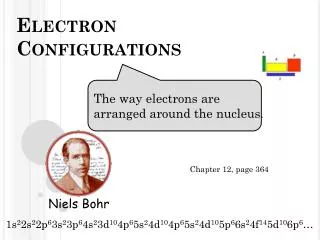
Niels Bohr (1885 – 1962) Increasing energy with greater distance from nucleus
} Bohr’s Model of Hydrogen Atom Fifth-excited • Further away from the nucleus means more energy. • There is no “in between” energy • Energy Levels Fourth Third Increasing energy Second First-ground Nucleus
Bohr’s Model of Hydrogen Atom quantum– quantity of energy gained or lost by an atom when electrons are excited photon– a quantum of light ground state – lowest energy level of an atom excited state – a heightened state of energy in an atom Electrons of hydrogen circle the nucleus in orbits 1. orbits have a fixed amount of energy in the ground state. 2. orbits are a fixed distance from the nucleus. 3.orbits furthest from the nucleus have the greatest energy.
Bohr’s Model of Hydrogen Atom Orbits Transitions of e between those orbits involve change in energy Change in energy (E(n2 –n1) has to be accounted for By photons Successful in accounting for most of the H-1 emission/absorption spectral lines BUT only works for H-1