'Insemination' presentation slideshows

Insemination - PowerPoint PPT Presentation


Artificial Insemination Cost in Lucknow - Elawoman

Artificial Insemination Cost in Lucknow - Elawoman

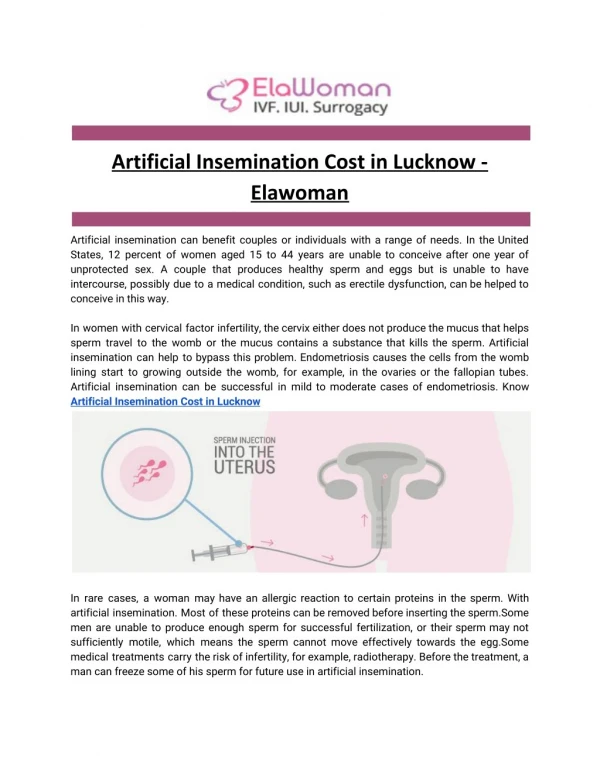
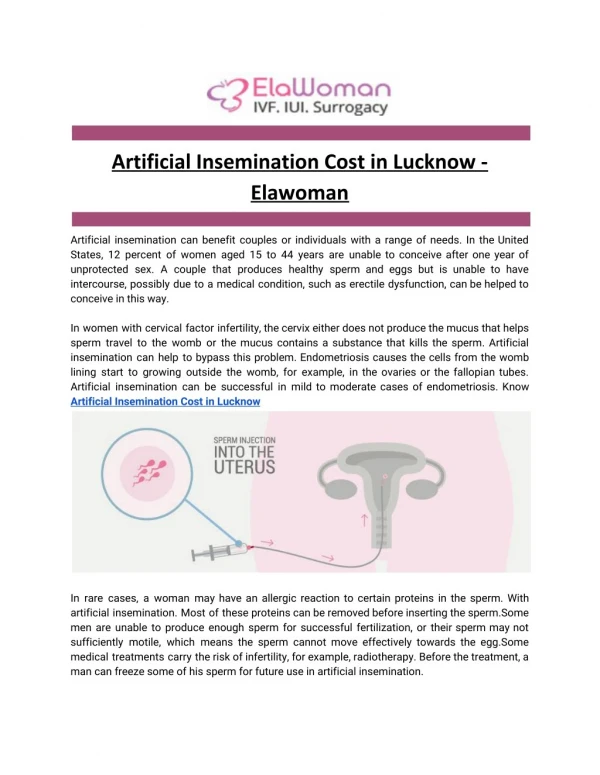
Artificial insemination can benefit couples or individuals with a range of needs. In the United States, 12 percent of women aged 15 to 44 years are unable to conceive after one year of unprotected sex. A couple that produces healthy sperm and eggs but is unable to have intercourse, possibly due to a medical condition, such as erectile dysfunction, can be helped to conceive in this way. In women with cervical factor infertility, the cervix either does not produce the mucus that helps sperm travel to the womb or the mucus contains a substance that kills the sperm. Artificial insemination can help to bypass this problem. Endometriosis causes the cells from the womb lining start to growing outside the womb, for example, in the ovaries or the fallopian tubes. Artificial insemination can be successful in mild to moderate cases of endometriosis. Know Artificial Insemination Cost in Lucknow In rare cases, a woman may have an allergic reaction to certain proteins in the sperm. With artificial insemination. Most of these proteins can be removed before inserting the sperm.Some men are unable to produce enough sperm for successful fertilization, or their sperm may not sufficiently motile, which means the sperm cannot move effectively towards the egg.Some medical treatments carry the risk of infertility, for example, radiotherapy. Before the treatment, a man can freeze some of his sperm for future use in artificial insemination.

109 views • 6 slides


Artificial Insemination Cost in Lucknow - Elawoman

Artificial Insemination Cost in Lucknow - Elawoman

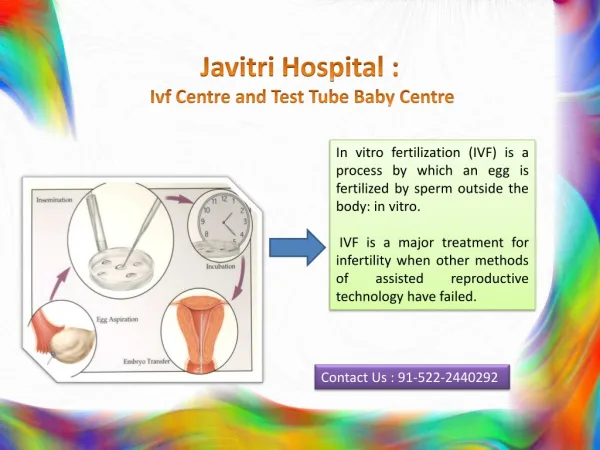
Artificial insemination can benefit couples or individuals with a range of needs. In the United States, 12 percent of women aged 15 to 44 years are unable to conceive after one year of unprotected sex. A couple that produces healthy sperm and eggs but is unable to have intercourse, possibly due to a medical condition, such as erectile dysfunction, can be helped to conceive in this way. In women with cervical factor infertility, the cervix either does not produce the mucus that helps sperm travel to the womb or the mucus contains a substance that kills the sperm. Artificial insemination can help to bypass this problem. Endometriosis causes the cells from the womb lining start to growing outside the womb, for example, in the ovaries or the fallopian tubes. Artificial insemination can be successful in mild to moderate cases of endometriosis. Know Artificial Insemination Cost in Lucknow In rare cases, a woman may have an allergic reaction to certain proteins in the sperm. With artificial insemination. Most of these proteins can be removed before inserting the sperm.Some men are unable to produce enough sperm for successful fertilization, or their sperm may not sufficiently motile, which means the sperm cannot move effectively towards the egg.Some medical treatments carry the risk of infertility, for example, radiotherapy. Before the treatment, a man can freeze some of his sperm for future use in artificial insemination.

104 views • 6 slides


best test tube baby center in delhi-www.ivf-india.co.in

best test tube baby center in delhi-www.ivf-india.co.in

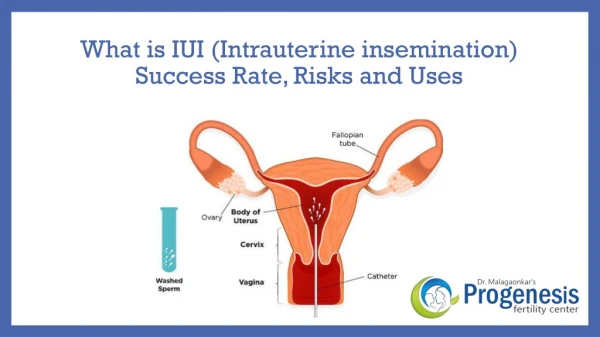
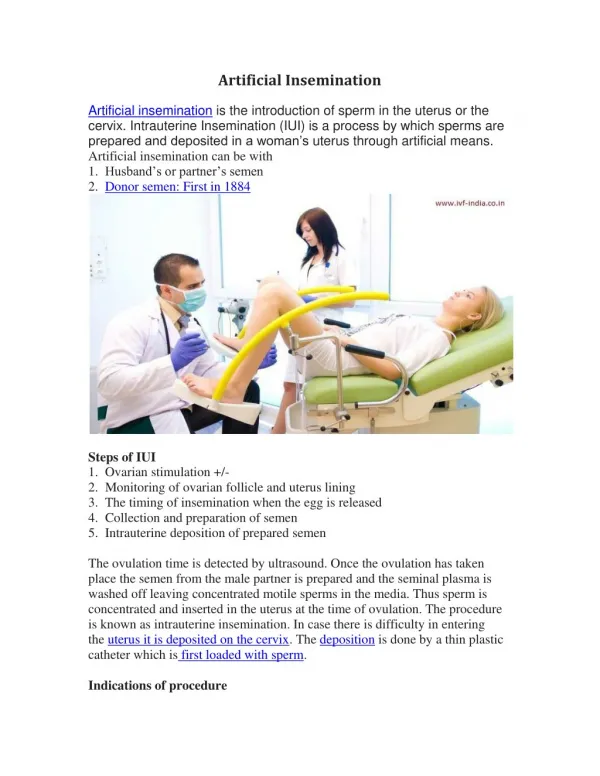
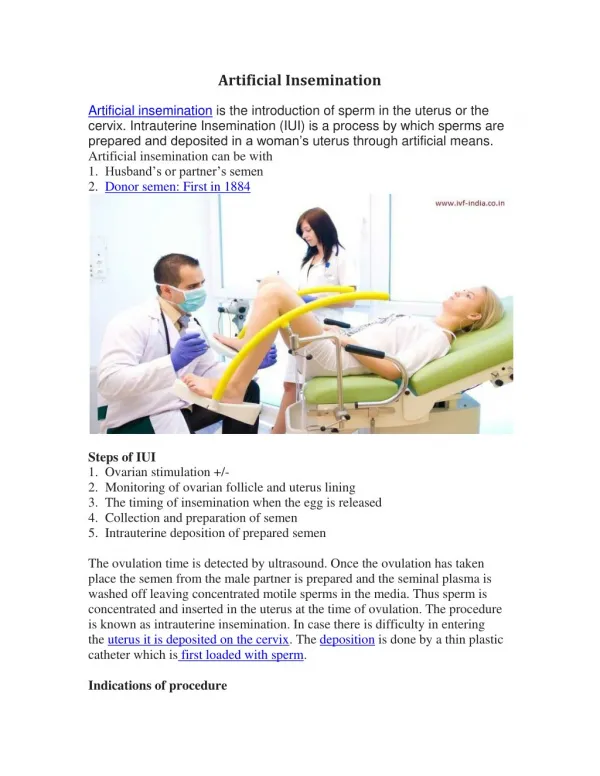
Artificial insemination is the introduction of sperm in the uterus or the cervix. Intrauterine Insemination (IUI) is a process by which sperms are prepared and deposited in a woman’s uterus through artificial means. Artificial insemination can be with 1. Husband’s or partner’s semen 2. Donor semen: First in 1884 Steps of IUI 1. Ovarian stimulation /- 2. Monitoring of ovarian follicle and uterus lining 3. The timing of insemination when the egg is released 4. Collection and preparation of semen 5. Intrauterine deposition of prepared semen The ovulation time is detected by ultrasound. Once the ovulation has taken place the semen from the male partner is prepared and the seminal plasma is washed off leaving concentrated motile sperms in the media. Thus sperm is concentrated and inserted in the uterus at the time of ovulation. The procedure is known as intrauterine insemination. In case there is difficulty in entering the uterus it is deposited on the cervix. The deposition is done by a thin plastic catheter which is first loaded with sperm. Indications of procedure 1. Where a couple is unable to have an intercourse 2. In case the sperm count is low 3. In case a woman is not ovulating drugs are given for ovulation and IUI timed 4. Where no cause is found – unexplained infertility 5. Immunological issues at the cervix Prerequisites for IUI 1. Tubes should be patent 2. Uterus must be adequate for pregnancy 3. The sperm count and motility should not be very low 4. A woman should be ovulating Factors to be considered before IUI 1. Age 2. Duration of infertility 3. Etiology of infertility 4. Extent of pathology 5. Ovarian reserve 6. Success rates 7. Cost 8. Previous treatment Success rates of IUI It has a pregnancy rate of 15-20%. The success rates are dependent on many factors. 1. Age – Success rates poor with older women. 2. Duration of Infertility - longer infertility poorer the success ratesIUI should be recommended with caution to couples with long-standing duration of infertility as results are poor. 3. Any pelvic factor like the blocked tube on one side or endometriosis has poor success rates 4. Poor ovarian reserve – Where ovaries are producing poor number and quality of eggs 5. Extremely low sperm counts and motility – Severe oligoasthenospermia 6. Where and how semen is prepared. A gap between IUI and semen preparation if less high success rates 7. If a patient has had more than 4 IUI it is not to be done as success rates very low Indications for therapeutic donor insemination 1. Azoospermia – No sperms 2. Male partner has a known hereditary or genetic disorder 3. Female partner is Rh-negative and severely Rh is immunized, and the male partner is Rh-positive 4. Severe deficits in semen quality or repeated failure to fertilize in IVF with ICSI being unacceptable to the couple 5. Females without male partners. 6. Male partner has uncorrectable ejaculatory dysfunction 7. Infectious disease in the male partner (such as HIV) - ASRM 2006 Guidelines for Sperm Donation

47 views • 3 slides


fertility clinic delhi-www.ivf-india.co.in

fertility clinic delhi-www.ivf-india.co.in

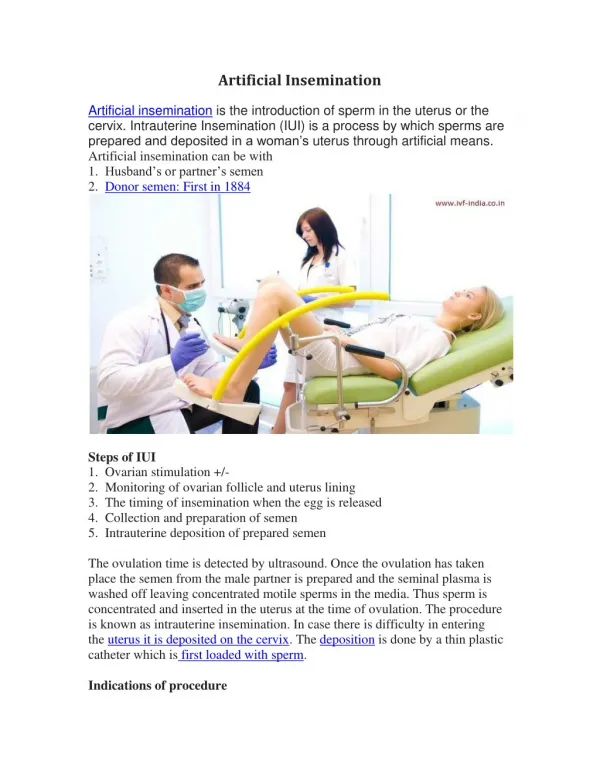
Artificial insemination is the introduction of sperm in the uterus or the cervix. Intrauterine Insemination (IUI) is a process by which sperms are prepared and deposited in a woman’s uterus through artificial means. Artificial insemination can be with 1. Husband’s or partner’s semen 2. Donor semen: First in 1884 Steps of IUI 1. Ovarian stimulation /- 2. Monitoring of ovarian follicle and uterus lining 3. The timing of insemination when the egg is released 4. Collection and preparation of semen 5. Intrauterine deposition of prepared semen The ovulation time is detected by ultrasound. Once the ovulation has taken place the semen from the male partner is prepared and the seminal plasma is washed off leaving concentrated motile sperms in the media. Thus sperm is concentrated and inserted in the uterus at the time of ovulation. The procedure is known as intrauterine insemination. In case there is difficulty in entering the uterus it is deposited on the cervix. The deposition is done by a thin plastic catheter which is first loaded with sperm. Indications of procedure 1. Where a couple is unable to have an intercourse 2. In case the sperm count is low 3. In case a woman is not ovulating drugs are given for ovulation and IUI timed 4. Where no cause is found – unexplained infertility 5. Immunological issues at the cervix Prerequisites for IUI 1. Tubes should be patent 2. Uterus must be adequate for pregnancy 3. The sperm count and motility should not be very low 4. A woman should be ovulating Factors to be considered before IUI 1. Age 2. Duration of infertility 3. Etiology of infertility 4. Extent of pathology 5. Ovarian reserve 6. Success rates 7. Cost 8. Previous treatment Success rates of IUI It has a pregnancy rate of 15-20%. The success rates are dependent on many factors. 1. Age – Success rates poor with older women. 2. Duration of Infertility - longer infertility poorer the success ratesIUI should be recommended with caution to couples with long-standing duration of infertility as results are poor. 3. Any pelvic factor like the blocked tube on one side or endometriosis has poor success rates 4. Poor ovarian reserve – Where ovaries are producing poor number and quality of eggs 5. Extremely low sperm counts and motility – Severe oligoasthenospermia 6. Where and how semen is prepared. A gap between IUI and semen preparation if less high success rates 7. If a patient has had more than 4 IUI it is not to be done as success rates very low Indications for therapeutic donor insemination 1. Azoospermia – No sperms 2. Male partner has a known hereditary or genetic disorder 3. Female partner is Rh-negative and severely Rh is immunized, and the male partner is Rh-positive 4. Severe deficits in semen quality or repeated failure to fertilize in IVF with ICSI being unacceptable to the couple 5. Females without male partners. 6. Male partner has uncorrectable ejaculatory dysfunction 7. Infectious disease in the male partner (such as HIV) - ASRM 2006 Guidelines for Sperm Donation

48 views • 3 slides


best ivf treatment-www.ivf-india.co.in

best ivf treatment-www.ivf-india.co.in

Artificial insemination is the introduction of sperm in the uterus or the cervix. Intrauterine Insemination (IUI) is a process by which sperms are prepared and deposited in a woman’s uterus through artificial means. Artificial insemination can be with 1. Husband’s or partner’s semen 2. Donor semen: First in 1884 Steps of IUI 1. Ovarian stimulation /- 2. Monitoring of ovarian follicle and uterus lining 3. The timing of insemination when the egg is released 4. Collection and preparation of semen 5. Intrauterine deposition of prepared semen The ovulation time is detected by ultrasound. Once the ovulation has taken place the semen from the male partner is prepared and the seminal plasma is washed off leaving concentrated motile sperms in the media. Thus sperm is concentrated and inserted in the uterus at the time of ovulation. The procedure is known as intrauterine insemination. In case there is difficulty in entering the uterus it is deposited on the cervix. The deposition is done by a thin plastic catheter which is first loaded with sperm. Indications of procedure 1. Where a couple is unable to have an intercourse 2. In case the sperm count is low 3. In case a woman is not ovulating drugs are given for ovulation and IUI timed 4. Where no cause is found – unexplained infertility 5. Immunological issues at the cervix Prerequisites for IUI 1. Tubes should be patent 2. Uterus must be adequate for pregnancy 3. The sperm count and motility should not be very low 4. A woman should be ovulating Factors to be considered before IUI 1. Age 2. Duration of infertility 3. Etiology of infertility 4. Extent of pathology 5. Ovarian reserve 6. Success rates 7. Cost 8. Previous treatment Success rates of IUI It has a pregnancy rate of 15-20%. The success rates are dependent on many factors. 1. Age – Success rates poor with older women. 2. Duration of Infertility - longer infertility poorer the success ratesIUI should be recommended with caution to couples with long-standing duration of infertility as results are poor. 3. Any pelvic factor like the blocked tube on one side or endometriosis has poor success rates 4. Poor ovarian reserve – Where ovaries are producing poor number and quality of eggs 5. Extremely low sperm counts and motility – Severe oligoasthenospermia 6. Where and how semen is prepared. A gap between IUI and semen preparation if less high success rates 7. If a patient has had more than 4 IUI it is not to be done as success rates very low Indications for therapeutic donor insemination 1. Azoospermia – No sperms 2. Male partner has a known hereditary or genetic disorder 3. Female partner is Rh-negative and severely Rh is immunized, and the male partner is Rh-positive 4. Severe deficits in semen quality or repeated failure to fertilize in IVF with ICSI being unacceptable to the couple 5. Females without male partners. 6. Male partner has uncorrectable ejaculatory dysfunction 7. Infectious disease in the male partner (such as HIV) - ASRM 2006 Guidelines for Sperm Donation

51 views • 3 slides


View Insemination PowerPoint (PPT) presentations online in SlideServe. SlideServe has a very huge collection of Insemination PowerPoint presentations. You can view or download Insemination presentations for your school assignment or business presentation. Browse for the presentations on every topic that you want.