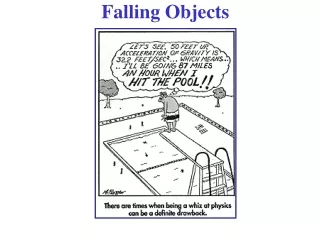
Understanding Falling Objects: Acceleration, Gravity, and Motion in a Vacuum
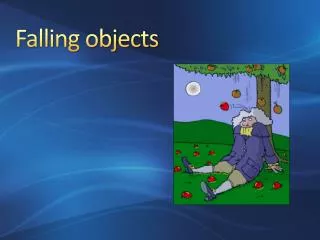
In this lecture, we explore the dynamics of falling objects, focusing on uniform acceleration due to gravity, which is a constant force of 9.8 m/s². We discuss how all dropped objects accelerate uniformly, regardless of mass. Key concepts include measuring acceleration, the effect of air resistance on different objects, and the behavior of objects in a vacuum. Practical examples, like dropping balls from buildings or throwing them with initial velocities, are presented to illustrate these principles. Students will compute average velocities, plot graphs, and analyze motion effectively.

Understanding Falling Objects: Acceleration, Gravity, and Motion in a Vacuum
E N D
Presentation Transcript
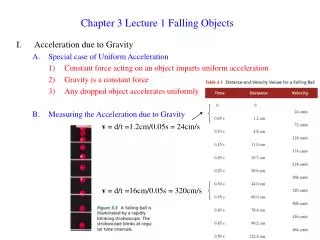
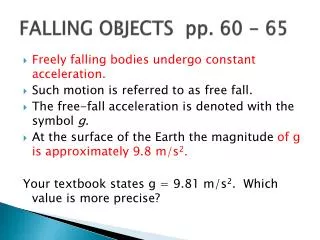
Chapter 3 Lecture 1 Falling Objects • Acceleration due to Gravity • Special case of Uniform Acceleration • Constant force acting on an object imparts uniform acceleration • Gravity is a constant force • Any dropped object accelerates uniformly • Measuring the Acceleration due to Gravity v = d/t =1.2cm/0.05s = 24cm/s v = d/t =16cm/0.05s = 320cm/s
Dy • Compute average velocity for each time period • Plot velocity versus time • Remember • Compute acceleration due to gravity: g = 9.8 m/s2 • Air Resistance • Which hits first, brick or a feather? • g is constant for all things; weight of the object doesn’t matter • Shape of a feather and its light weight do cause it to interact with the air strongly = air resistance • Large surface area • Small weight • In a vacuum (no air) all things fall at the same rate (on Earth) Dx
v = vo + at d = vot + ½ at2 • Tracking Falling Objects • Ball dropped from a building • Find velocity and distance at 0.5-2 s • Plot distance vs. time
Throwing a ball straight down • Now we have an initial velocity v0 • Acceleration due to gravity is still g = 9.8 m/s2 • Ball is thrown down at 20 m/s. What are the velocities and distances at 1 and 2 seconds? • Throwing a ball straight up • Direction of velocity and acceleration are very important • What is the acceleration at the top of the trajectory? What is the velocity? - a - a + v - v


![Chapter 3. [Lecture 02] Introduction to Classes and Objects](https://cdn5.slideserve.com/9601622/chapter-3-lecture-02-introduction-to-classes-and-objects-dt.jpg)