Download
1 / 10
110 likes | 259 Views
Explore effective strategies for teaching multiplication with model-based approaches. This resource highlights activities that use blocks to represent expressions and encourages students to visualize multiplication through rectangles and squares. Emphasis on the commutative property lays a strong foundation, while reasoning techniques target 75% of multiplication facts. From doubling strategies to nifty nines, students will engage in skip counting and word problem practices. This comprehensive guide enhances understanding and mastery of multiplication concepts for all learners.

E N D
Strategies for Multiplication Lacey Unruh, Sara Fisher, and Leslie Jones
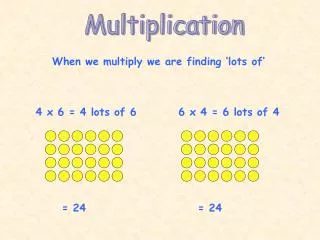
Model-Based Equal Sets Array Number Line 4+4+4+4=16
Model-Based Example Activity: Find as many multiplication expressions for 30 as possible using your blocks, make your expressions into rectangles/squares. Then draw your expression on your paper and write an addition AND multiplication equation to represent your blocks.
Reasoning • Before introducing these strategies make sure students have a strong understanding of the commutative property. • The following reasoning strategies cover 75 of the 100 multiplication facts.
Doubles 3 X 2 = 6 Facts that have 2 as a factor are equivalent to the addition doubles 3 + 3 = 6 Try word problems where 2 is the number of sets, then later switch it up where 2 is the size of sets 5 + 5 = 10 2 X 5 = 10
Fives 5 45 10 Practice skip counting by 5’s at least to 45. http://www.youtube.com/watch?v=GTYxfltyPgg 40 15 20 35 30 25
Zeros and Ones • 36 facts have at least one factor that is either 0 or 1. • Addition problems such as 4 + 0 = 4 can be confused with 4 x 0 = 0. • Ask students to put words with equations • 6 x 0 = 0 in words would be 6 groups of 0 equals 0. • Avoid “rules” such as “any number multiplied by zero is zero.”
Nifty Nines • 3 different patterns for learning 9’s • The tens digit of the product is always one less than the “other” factor and the sum of the two digits in the product is always 9. • Example: 7 x 9, 1 less than 7 is 6, 6 and 3 make 9, so the answer is 63.
Nifty Nines • 7 x 9 is the same as 7 x 10 minus 7. • Students can easily subtract 6 from 60, 5 from 50, 4 from 40, etc…
Nifty Nines • Fingers for finding products of nines • These strategies can be confusing-challenge students to think about why this pattern exists.