Some Definitions
This guide explores the concepts of steric number and molecular geometry, essential for understanding chemical bonding and structure. The steric number is defined as the sum of bonded atoms and lone electron pairs around a central atom, while the coordination number indicates the number of atoms directly bonded to it. We will differentiate between electron geometry and molecular geometry, discuss bond angles, and provide examples for various steric numbers from 2 to 6. This foundational knowledge is crucial for predicting molecular shapes and reactivity.

Some Definitions
E N D
Presentation Transcript
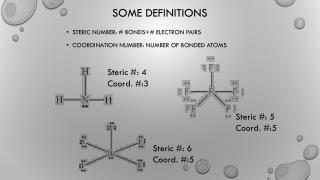
Some Definitions • Steric Number: # bonds+# electron pairs • Coordination Number: number of bonded atoms Steric #: 4 Coord. #:3 Steric #: 5 Coord. #:5 Steric #: 6 Coord. #:5
Some (more) Definitions • Electron geometry: geometry including if you “saw” electron pairs • Molecular geometry: geometry where you don’t “see” electron pairs • Bond angle: angle between bonds. EG:Tetrahedral MG: Trig. pyramidal EG:Trig. bipyramidal MG: Trig. bipyramidal EG:Octahedral MG: Square Pyramidal
Pull out your worksheet, candy and toothpicks! Thanks to http://www.chemmybear.com/shapes.html for all animations on following slides!
Steric Number 3 Examples: SO3, BF3, CO32- Examples: SO2, CCl2
Steric Number 4 Examples: CH4, SiH4, PO4 Examples: NH3, PI3 Examples: H2O, OF2
Steric Number 5 Examples: PCl5, SbF5 Examples: TeCl4, SF4 Examples: ClF3, SeO32- Examples: I3-, XeF2
Steric Number 6 Examples: XeF4, ClF4- Examples: IF5, BrF5 Examples: SF6, Mo(CO)6