
Maternal and Neonatal Medical Fundamentals: Key Concepts for Nursing Practice
This resource provides essential knowledge on maternal and neonatal medical topics, focusing on surgical fundamentals, drug choices for preterm infants, and postpartum complications. Learn about the significance of fimbriae in ovulation, management of uterine atony, signs of increased intracranial pressure, and classic symptoms of tuberculosis. It also covers nursing licensure requirements, defense mechanisms in child behavior, and necessary precautions for infectious diseases. This comprehensive overview is crucial for nursing professionals working in maternal and neonatal care.

Maternal and Neonatal Medical Fundamentals: Key Concepts for Nursing Practice
E N D
Presentation Transcript
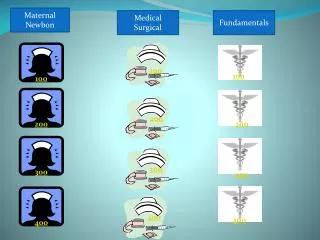
gamescreen Maternal Newbon Medical Surgical Fundamentals 100 100 100 200 200 200 300 300 300 400 400 400
100 • These fingerlike projections hover over each ovary and “capture” the ovum as it is released by the ovary at ovulation
100 • fimbriae
200 • Betamethasone is the drug of choice to enhance this substance in infants born between 24 and 34 weeks
200 • surfactant
300 • A soft, boggy uterus located 2cm above the umbilics with increased and clotted lochia are signs of this postpartum complication
300 • Uterine Atony
400 • Left • Occiput • Posterior
100 • Deep calf pain upon dorsiflexion of the foot is known as
100 • A positive Homan’s sign
200 • Headache • Altered level of consciousness • Sluggish pupil reaction • Widening pulse pressure • These are all signs of :
200 • Increased • Intracranial • Pressure
300 • Low grade fever • Night sweats • Anorexia • Weight loss • Fatigue • These are classic symptoms of this disease
300 • Tuberculosis
400 • A pressure ulcer with full thickness tissue loss in which subcutaneous fat is visible but bone, tendon and muscle are not exposed can be staged as
400 • Stage 3 pressure ulcer
100 • This defines the activities in which the nurse may engage, states the legal requirements and titles for nursing licensure and establishes the education needed for licensure
100 • Nurse • Practice • Act
200 • A child who has been scolded by her mother hits her younger sibling with a hair brush. This is an example of which type of defense mechanism?
200 • Displacement
300 • Measles • Varicella • Tuberculosis • All call for this type of isolation precaution
300 • Airborne • Precautions
400 • this element is the major extracellular cation and is essential in the transmission of nerve impulses and helps maintain neuromuscular irritability
400 • Sodium • (Na+)