Understanding Isosceles Triangle Theorems and Properties
130 likes | 265 Views
This resource explores the fundamental properties of isosceles triangles, focusing on key theorems such as the Isosceles Triangle Theorem, which states that if two sides are congruent, the angles opposite those sides are also congruent. It elaborates on related concepts such as the importance of angle bisectors and congruency in triangles. The text also addresses equilateral triangles and their unique properties, including connections between angle measures and side lengths. Practice problems are included to reinforce understanding of these concepts.


Understanding Isosceles Triangle Theorems and Properties
E N D
Presentation Transcript
4.6 The Isosceles Triangle Theorems Base Angles and Opposite Sides Hypotenuse - Leg
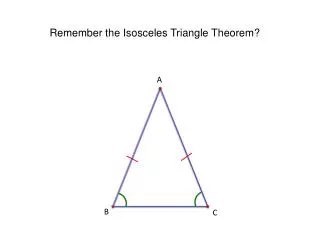
Isosceles Triangle Theorem If two sides of a triangle are congruent, then the angles opposite those sides are congruent.
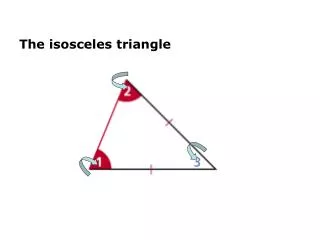
Isosceles Triangle Theorem If two sides of a triangle are congruent, then the angles opposite those sides are congruent. Given: Bisect angle A So by SAS So By C.P.C.T.
Corollary of Isosceles Triangle Theorem An equilateral triangle is also equiangular An equilateral triangle has three 60 degree angles. The bisector of the vertex angle of an isosceles triangle is perpendicular to the base at its midpoint.
Another Theorem If two angles of a triangle are congruent, then the sides opposite those angles are congruent. What is this compared to the Isosceles Triangle Theorem? An equiangular triangle is also equilateral.
Solve for angles… 2,3,4 Given:
Hypotenuse – Leg (HL) In two right triangles if the hypotenuse and one leg are congruent, then the triangles are congruent. To use this you must show Right Triangles
Homework Page 239 – 242 # 9 – 25 odd, 34 -37, 39
Homework Page 239 – 242 # 8 -24 even 29- 33