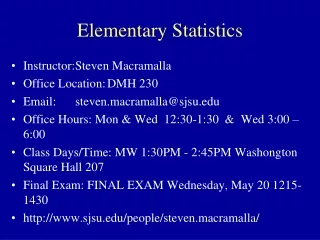
Elementary Statistics
This webpage provides essential information for the Elementary Statistics course for Fall 2008. It includes details about the course syllabus, schedule, practice materials, and homework assignments. Important notes on exam formats, attendance policies, project expectations, and communication guidelines are outlined. Students are reminded to activate their STLCC email accounts to ensure they receive all course-related communications sent via Blackboard. A strong understanding of the material is required, along with group work that will contribute to the homework score.

Elementary Statistics
E N D
Presentation Transcript
Elementary Statistics Fall 2008
About Me… • Where I’m from:
About Me… • My “kids”…
About Me… • My personality…
Webpage • http://web.missouri.edu/~dls6w4 • Syllabus • Calendar • Practice Materials • Homework • Exam Information
Blackboard • Make sure you have access to Blackboard • You must either: • Activate your stlcc email account • Update Blackboard to different email • Otherwise, you will not receive emails • You are still responsible for all emails sent regardless of receipt • When/if you send me an email, please put “Stats Night” in the subject line • If you do not, I won’t answer it
Homework Homework • “Long and painful” • Absences will not excuse you from completing homework • All will be posted on the webpage • You’ll need to have a strong understanding of the material • Group work… • I will take your top 5 scores • I do not know how many we will have
Exams 4 exams • Final is cumulative • I will drop your lowest exam score of the first three • The final exam counts • You will be allowed a notecard for formulas and a non-programmable calculator
Project • Paper, no minimum page requirement • Do something that interests you • Check webpage for details/deadlines • Failure to complete the paper as required will result in the loss of an additional letter grade
Attendance • Attendance includes being present, but it also includes: • Not disrupting class • Being attentive • Not excessively talking • Not doing anything I deem “annoying” • This will cost you attendance credit • If you come in after roll call, it is your job to notify me in person that day
Point Breakdown • Exams: 60% • Three Midterm exams: 100 points each • Final Exam (cumulative): 100 points • Homework: 30% • Each homework worth fifty points each • I’ll count the top 5 • Project: 10% • Attendance: Loss of 3%
Exam I Material Introductory Material
Some Basics • Descriptive Statistics • Allow us to get a sense of things • Inferential Tools • Allow us to reach some conclusion • Estimation, Hypothesis Testing
Where does data come from? • Experiments • Process generating outcomes • Design is important • Surveys • Closed-end Questions • Open-end Questions • Demographics • Interviews/Observation
Stop and Think • What kinds of things can go wrong with surveys?
What can go wrong? • Potential Problems • Interviewer Bias • Non-response Bias • Selection Bias • Observer Bias • Measurement Error • Validity • Internal – Eliminating useless info • External – Results beyond original
Key Terms • Population • All possible observations • Sample • A portion of the population • Is error (sample) worth the lower cost (population)?
Sampling Techniques • Statistical Sampling – Based on chance • Nonstatistical Sampling – Not on chance • Simple Random Sampling – All possible • Stratified Random Sampling – Into levels • Systematic Random Sampling – Every kth • Cluster Sampling – Break into groups
Types of Data • Quantitative v. Qualitative • Quantitative – Numerical • Qualitative – Categorical • Time-series v. Cross-Section • Time-series – one value, many times • Cross-section – many values, one time
What level are the data? • Nominal – Simplest form, no rank implied • Ordinal – Rank data • Interval – Difference measure, no true zero • Ratio – Consistent, true zero
Describing Data • Frequency Distribution • Reports how often values occur • Classifies observations by class • Relative Frequency • How often one value occurs compared to sample • Usually expressed in percentage • RF = (fi)/(n)
Describing Data • Grouped Frequency Distribution • Classifies data into groups • Groups must be: • Mutually Exclusive • All-Inclusive • Equal-Width • Free of empty classes (if possible)
Describing Data • Grouped Frequency Distribution • How to determine groups • Determine number of groups (2k≥n) • Establish width of classes • Determine boundaries for classes • Count values in each class • Both types can be built into a histogram • Also can construct Cumulative Frequency Distribution and build an ogive
Describing Data • Other methods • Bar Chart • Pie Chart • Stem-and-Leaf Diagram • Line Chart (Time graph) • Scatter Plot • Can see relationship between X and Y • Demand/Supply curves (Economics)
Describing Data • May want to examine two variables • Use Joint Frequency Distribution • How? • Get data containing two responses • Build table • Find joint occurrences • Sum rows and columns for marginal frequencies
Numerical Measures • We’ve done some simple measures • Now let’s actually do some calculations • Before we start: • Parameter-based on population • Statistic-based on sample
Center and Location • Population Mean (μ) • A.k.a. average • For population, sum of deviations=0 • Sample Mean (x-bar) • Based on a selected sample • All means subject to distortion by extrema
Center and Location • Median • Middle value of the data • Odd-numbered sample=find middle • Even-numbered sample=find middle of middle two
Center and Location • Taken together, the mean and median show skewness of data • Median>Mean = Left Skewed • Median<Mean = Right Skewed
Center and Location • Mode • Value occuring most often • Occasionally, a set of data has no mode
Center and Location • Weighted Mean • Same idea as mean, just unequal weights on observations • Percentiles • Describes where a particular value is located in data • i = (p/100)*(n) • If i is integer – average (i, i + 1) • If i is not integer – round up • Quartiles • Dividing the data into four equal parts • “Qua” implies four (quarter, quart, etc.)
Be careful! • These not always useful for qualitative data masquerading as quantitative • Need further assumptions/theory to hold
Measures of Variation • Variation – The “spread” of the data • Range = Maximum – minimum • Sensitive to extrema • Considered weak • Interquartile Range = Third Q – First Q • Softens dependence on extrema
Measures of Variation • Variance (σ2) • Measure of dispersion or spread • Equation… • Shortcut… • Standard Deviation (σ) • √VAR • Sample (s2, s) and Population calculated in similar fashion • Use n-1 instead of N in denominator
Combining μ and σ • Coefficient of Variation (CV) • Relative variation with different means • (σ/μ)*(100%) for population • Replace with sample measures for sample CV • Empirical Rule (with bell-shape) • 68% within μ ± σ • 95% within μ ± 2σ • “All” within μ ± 3σ
Standardizing Values • Allows us to compare different data effectively • Z-value (population) = (x – μ)/σ • X is value of interest • Based on a standard normal distribution • Mean = 0, Variance = 1 • This will be important from now until the end
Probability • The chance that something will happen • Sample Space – all possible events • Event – Element(s) of sample space • Mutually Exclusive • Independence v. Dependence • Ways to determine • Classical • Relative Frequency • Subjective
Probability • Some rules to know… • All probabilities are between 0 and 1 (incl.) • The sum of all probabilities is 1 • Complement Rule • Probability of X = 1 – Probability of all others • Addition Rule • Probability of X or Y = Pr(X) + Pr(Y) – Pr(X and Y) • If events mutually exclusive = Pr(X) + Pr(Y)
Probability • Some simple examples • Probability of tails on fair coin? • Probability of rolling a 1 or 6 on fair die? • Probability of drawing a heart from standard deck?
Probability • Conditional Probability • The probability that one event occurs when you know something else has happened • Pr(X|Y) = Pr(X and Y)/Pr(Y) • If the events are independent, =Pr(X) • Multiplication Rule • Pr(X and Y) = Pr(X)(Pr(Y|X)) • Independent = Pr(X)Pr(Y)