Download
1 / 10
100 likes | 223 Views
This resource explores the different types of solutions, including solutes, solvents, suspensions, and colloids. A solution is a homogeneous mixture consisting of a solute and a solvent. The solute dissolves in the solvent — water, often referred to as the universal solvent, being a prime example. We will identify various kinds of solutions based on particle size and characteristics, and discuss how the properties of solutions change with the addition of solutes. Relevant examples such as saltwater, milk, and muddy water will also be highlighted.

E N D
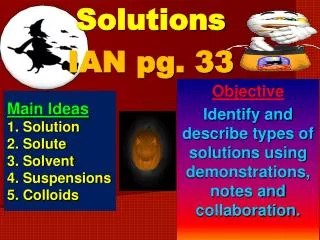
Objective Identify and describe types of solutions using demonstrations, notes and collaboration. Main Ideas1. Solution2. Solute3. Solvent4. Suspensions5. Colloids Solutions IAN pg. 33
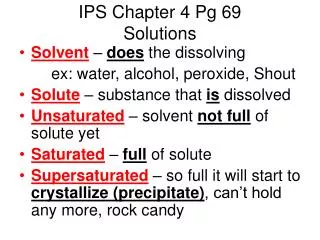
Solutions are one kind of mixture that contain a solute and a solvent with molecular size particles less than 10-7 cm. A. Solute is the substance that dissolves in solution. Examples: Salt, Sugar, Carbon Dioxide
B. Solvent is the substance that dissolves a solute and makes up the greatest portion of a solution. Example: Water is the universal solvent!
Example: Salt (a solute) is dissolved in water (a solvent) C. Solutions are homogeneous O2 + N2 H2O + NaCl SOLVENT SOLUTE SOLUTE SOLVENT
D. Solutes & Solvents can be are found in any state SoluteSolvent 1. Gas Gas 2. Gas Liquid 3. Liquid Liquid 4. Liquid Solid 5. Solid Solid 6. Solid Gas
E. Suspensions are mixtures that have large particlesgreater than 10-5 cm, that will settle to the bottom. F. Colloids are mixtures the have particles between 10-7 to 10-5cm evenly dispersed in a continuous gaseous, liquid, or solid medium. Examples include: Milk, mayonnaise, milk, butter, jelly, muddy water, and paper.
IAN Page 32 The whole page! 4 Colors! TYPES OF SOLUTIONS
G. Solute & Solvent interactions 1. Ionic compounds (solute) Dissolve in solution = Solutions 2. Covalent compounds(solute) spread out in solution = Colloids or Suspensions
H. Properties of the solution change when a solute is added to a solvent. 1. Freezing point increases or decreases 2. Boiling point increases or decreases
Fold in IAN page 32 Matching “cut out” worksheet on Solutions.