Download
1 / 37
370 likes | 494 Views
This study presents an in-depth analysis of pavement quality based on surveys conducted between 2009 and 2012, highlighting the challenges faced in maintaining county roads and the costs associated with rehabilitation. It includes comparisons of expenditures to other counties, outlines the types of roads within the county—from arterial networks to local subdivision roads— and discusses public input regarding rehabilitation initiatives. Emphasis is placed on the need for long-term improvement strategies, addressing inflation, and the inefficiencies in current policies.

E N D
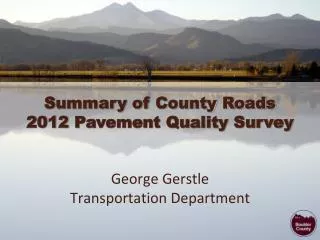
Pavement Quality SurveyStudy Session • 2012 Pavement Quality Survey Results • Rehabilitation Costs • Recent Public Input/Activity • Comparison of County R&B Expenditures to Other Counties • Current Challenges • Options/Direction
County Road System • State Highways
County Road System • State Highways • Municipal System
County Road System • State Highways • Municipal System • County Connections
County Road System • Types of Roads • (Classifications) • Arterial Network
County Road System • Types of Roads • (Classifications) • Arterial Network • Collector Roads(gravel & paved)
County Road System • Types of Roads • (Classifications) • Arterial Network • Collector Roads(gravel & paved) • Local Roads (and sub-divisions)
Centerline Miles of County Maintained Roads(Source: 2008 HUTF Report)
How is the Condition of a Paved Road Measured? • A special van drives every paved road in the county and measures pavement distress (ie cracking/potholes, etc) with laser measuring device. • Based on the number and depths of cracks, each section of road is rated is given a Pavement Quality Index number, or PQI, from 1 (Bad) to 10 (perfectly paved). • Surveys are conducted every three years • The most recent survey cost $45,000 4 high-speed lasers measure cracking across the width of the lane. How lasers see a crack
Current Challenges • Time = $ • Inflation • Continued Deterioration • Increased Maintenance Costs • Optimal Improvement Strategy • Worst first • Long term cost effectiveness • Broad distribution of improvements • Challenge with current policy • Inefficiency/Admin. Complexity • Bonding Costs • Divisive • Support only when roads are bad and expensive
Summary of Subdivision Pavement 5 Year Rehab. Program Cost Comparison 2009 - 2012
Challenge With Current Policy • Inefficiency/Admin. Complexity • > 100 subdivisions with paved roads • Many with no functioning HOA • Divisive • Difficult for neighbors to advocate on divisive issue • Bonding Costs • Costs of bonding/interest large % of total cost • Relatively more expensive for small subdivisions • Support only when roads are bad and expensive • Local support when roads are very bad • Most expensive to fix
Status of Recent Subdivision Resident Input • Subdivision Paving Working Group • Multiple Meetings and Outreach • Website/Petition • 287 Signatures supporting creation of countywide subdivision LID for rehabilitation of sub. roads • 6 HOA Representatives signed petitions
Status of Recent Subdivision Resident Input • Niwot Public Improvement District • Survey of support for placing question on ballot • 2,549 survey postcards sent • 894 returned (35% response) • 65% of eligible voters did not respond • Of those who responded: • 607 (68%) support/287 (32%) opposed • 24% of eligible voters support placing on ballot • 11% of eligible voters oppose placing on ballot Cost to average home in Niwot • $422/yr. for years 1- 6 • $223/yr. from year 7 out
Status of Recent Subdivision Discussions • Pinebrook Hills – Unsuccessful LID • Crestview Estates – Unsuccessful LID • Reserve - Potential Rehab. With HOA fees • Gunbarrel Estates – Petition Process Initiated • Gunbarrel Green - Discussion • Homestead - Discussion • South Meadow - Discussion • Shannon Estates - Discussion • Lake Valley – Discussion
Recent Subdivision Resident Input • Already pay sufficient/too much taxes. • Roads should be rehabilitated from existing sources. • It is County responsibility to maintain public roads/County should live up to responsibility. • County violated commitment to maintain roads when they were accepted for maintenance. • County should re-arrange budget priorities/divert funds from other uses. • Many who support creation of LID, share sentiments, but believe situation is critical, and need to create LID ASAP.
Options/Direction • Maintain Current Policy • Individual Subdivision Initiatives/Improvement Districts • County Contribution • Create Countywide Subdivision Public Improvement District w/ Vote • Create Countywide Subdivision Local Improvement District w/current authority
Issues For Consideration : • Include NiwotPID /Reserve in LID? • Balance between revenue constrained and need? • Time period for an improvement program? • Appropriate inflation factor? • Appropriate contingency factor? • County contribution?