
Leaves of Monocots have parallel veins (tubes), while Dicots have branching tubes.
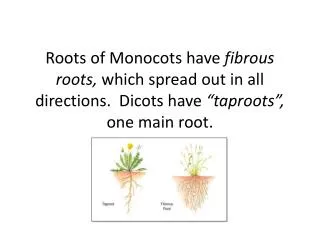
Roots of Monocots have fibrous roots, which spread out in all directions. Dicots have “taproots”, one main root. Stems of Monocots have scattered bundles of veins (tubes). In Dicots, bundles of tubes are neatly arranged in a circle.

Leaves of Monocots have parallel veins (tubes), while Dicots have branching tubes.
E N D
Presentation Transcript
Roots of Monocots have fibrous roots, which spread out in all directions. Dicots have “taproots”, one main root.
Stems of Monocots have scattered bundles of veins (tubes). In Dicots, bundles of tubes are neatly arranged in a circle.
Seeds of Monocots have one cotyledon and the endosperm. The cotyledon does not emerge from the ground. Dicot seeds have two cotyledons, which include the endosperm.
Leaves of Monocots have parallel veins (tubes), while Dicots have branching tubes.
Flowers of Monocots grow in multiples of 3. Dicot flower parts grow in multiples of 2, 4, and 5.