Urinary System
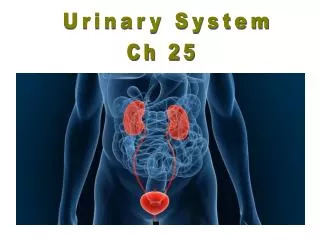
The urinary system plays a crucial role in filtering waste materials from the body while maintaining homeostasis by regulating fluid status, electrolyte balance, and acid-base balance. It also has important endocrine functions, producing substances like erythropoietin (EPO) for red blood cell production, active Vitamin D for calcium absorption, and renin for blood pressure regulation. The anatomy of the kidneys includes components such as the renal hilus, cortex, medulla, and nephron structure, which consists of complex blood vessel arrangements ensuring efficient filtration and blood flow.

Urinary System
E N D
Presentation Transcript
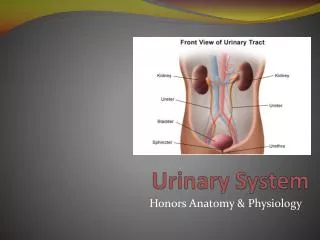
Urinary System Introduction • The urinary system Filters the body of waste materials ,Homeostaticalyregulates bodys fluid status,electrolyte balance and acid base balance. Endocrine and Synthetic functions • EPO • Controls RBC production from stem cells in marrow • Stimulated by reduced PO2 in kidney (not systemic PO2) • Vitamin D • Active form (calcitrol) produced by a hydroxlation in kidney & liver • Important for calcium absortion from GI and also neuronal development in-utero • Renin • An enzyme. Synthesized in juxtaglomerular (granular) cells in afferent arteriole • Stimulated by a fall in circulating volume • Leads to the production of Ang II and Aldosterone
Basic Anatomy of the Kidney Renal Hilus: Renal artery, vein, nerves, lymphatics & renal pelvis Cortex Medulla: Renal Pyramids Medullary rays Papilla
Internal Structure of the Kidney 85% 15%
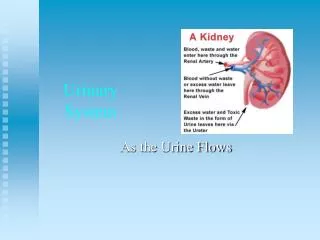
Nephron Structure: Associated Blood Vessels Renal → segmental → interlobar → arcuate → cortical radial (interlobular) → afferent → glomerulus → efferent Two arterioles and two capillary beds in series The Kidney Has The Highest Blood Flow Per Unit Mass Among Major Organs. 1250 ml/min = 25% of cardiac output