Download
1 / 35
350 likes | 465 Views
This document delves into the concept of deadlock in computer systems, defining its characteristics and real-world analogies such as traffic on a one-lane bridge. It explores the conditions necessary for deadlock, including mutual exclusion, hold-and-wait, no preemption, and circular wait. Various strategies for deadlock management are also discussed, including prevention, avoidance, detection, and recovery techniques. The implications of each method on system efficiency and resource allocation are highlighted, guiding the design of systems to minimize deadlock occurrences.

E N D
Deadlock Solutions CS 241 March 28, 2012 University of Illinois
Announcements • Office hours today: 3-4 and 5-6 • In between: Talk by Tom Wenisch • Energy efficiency in warehouse-scale computers • 4pm, in 3405 SC • Midterm exams: you may look at them through the end of this week • An extension of our one-week policy • Drop by office hours today (3-4 and 5-6) or schedule appointment
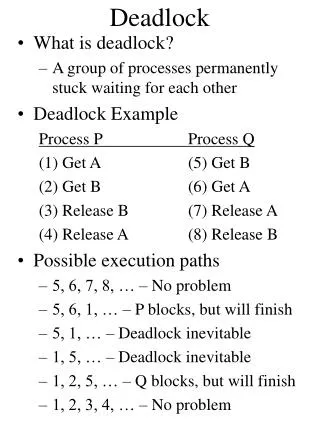
Deadlock: definition • There exists a cycle of processes such that each process cannot proceed until the next process takes some specific action. • Result: all processes in the cycle are stuck!
Deadlock in the real world Which way should I go?
Deadlock in the real world I can almost get across Drat! GRIDLOCK!
Deadlock: One-lane Bridge • Traffic only in one direction • Each section of a bridge can be viewed as a resource What can happen?
Deadlock: One-lane Bridge • Traffic only in one direction • Each section of a bridge can be viewed as a resource • Deadlock • Resolved if cars back up (preempt resources and rollback) • Several cars may have to be backed up
Deadlock: One-lane Bridge • Traffic only in one direction • Each section of a bridge can be viewed as a resource • Deadlock • Resolved if cars back up (preempt resources and rollback) • Several cars may have to be backed up • But, starvation is possible • e.g., if the rule is that Westbound cars always go first when present
Deadlock: One-lane Bridge • Deadlock vs. Starvation • Starvation = Indefinitely postponed • Delayed repeatedly over a long period of time while the attention of the system is given to other processes • Logically, the process may proceed but the system never gives it the CPU (unfortunate scheduling) • Deadlock = no hope • All processes blocked; scheduling change won’t help I always have to back up!
Deadlock solutions • Prevention • Design system so that deadlock is impossible • Avoidance • Steer around deadlock with smart scheduling • Detection & recovery • Check for deadlock periodically • Recover by killing a deadlocked processes and releasing its resources • Do nothing • Prevention, avoidance and detection/recovery are expensive • If deadlock is rare, is it worth the overhead? • Manual intervention (kill processes, reboot) if needed
Aside: Necessary Conditions for Deadlock • Mutual exclusion • Processes claim exclusive control of the resources they require • Hold-and-wait (a.k.a. wait-for) condition • Processes hold resources already allocated to them while waiting for additional resources • No preemption condition • Resources cannot be removed from the processes holding them until used to completion • Circular wait condition • A circular chain of processes exists in which each process holds one or more resources that are requested by the next process in the chain
Deadlock prevention • Goal 1: devise resource allocation rules which make circular wait impossible • Resources include mutex locks, semaphores, pages of memory, ... • ...but you can think about just mutex locks for now • Goal 2: make sure useful behavior is still possible! • The rules will necessarily be conservative • Rule out some behavior that would not cause deadlock • But they shouldn’t be to be too conservative • We still need to get useful work done
Rule #1: No Mutual Exclusion • For deadlock to happen: processes must claim exclusive control of the resources they require • How to break it?
Rule #1: No Mutual Exclusion • For deadlock to happen: processes must claim exclusive control of the resources they require • How to break it? • Non-exclusive access only • Read-only access • Battle won! • War lost • Very bad at Goal #2
Rule #2: Allow preemption • A lock can be taken away from current owner • Let it go: If a process holding some resources is denied a further request, that process must release its original resources • Or take it all away: OS preempts current resource owner, gives resource to new process/thread requesting it • Breaks circular wait • ...because we don’t have to wait • Reasonable strategy sometimes • e.g. if resource is memory: “preempt” = page to disk • Not so convenient for synchronization resources • e.g., locks in multithreaded application • What if current owner is in the middle of a critical section updating pointers? Data structures might be left in inconsistent state!
Rule #3: No hold and wait • When waiting for a resource, must not hold others • So, process can only have one resource locked • Or, it must request all resources at the beginning • Or, before asking for more: give up everything you have and request it all at one time • Breaks circular wait • In resource allocation diagram: process with an outgoing link must have no incoming links • Therefore, cannot have a loop!
Rule #3: No hold and wait • Breaks circular wait • In resource allocation diagram: process with an outgoing link must have no incoming links • Therefore, cannot have a loop! • Q: Which of these request links would be disallowed? Process request ownership Resource
Rule #3: No hold and wait • Breaks circular wait • In resource allocation diagram: process with an outgoing link must have no incoming links • Therefore, cannot have a loop! • A: Legal links are... Process request ownership Resource
Rule #3: No hold and wait • Very constraining (bad job on Goal #2) • Better than Rules #1 and #2, but... • Often need more than one resource • Hard to predict at the begining what resources you’ll need • Releasing and re-requesting is inefficient, complicates programming, might lead to starvation
Rule #4: request resources in order • Must request resources in increasing order • Impose ordering on resources (any ordering will do) • If holding resource i, can only request resources > i • Much less constraining (decent job on Goal #2) • Strictly easier to satisfy than “No hold and wait”: If we can request all resources at once, then we can request them in increasing order • But now, we don’t need to request them all at once • Can pick the arbitrary ordering for convenience to the application • Still might be inconvenient at times • But why is it guaranteed to preclude circular wait?
Dining Philosophers solution with unnumbered resources Back to the trivial broken “solution”... # define N 5 void philosopher (inti) { while (TRUE) { think(); take_fork(i); take_fork((i+1)%N); eat(); /* yummy */ put_fork(i); put_fork((i+1)%N); } }
Dining Philosophers solution with unnumbered resources Back to the trivial broken “solution”... # define N 5 void philosopher (inti) { while (TRUE) { think(); take_fork(i); take_fork((i+1)%N); eat(); /* yummy */ put_fork(i); put_fork((i+1)%N); } }
Dining Philosophers solution with unnumbered resources Back to the trivial broken “solution”... # define N 5 void philosopher (inti) { while (TRUE) { think(); take_fork(i); take_fork((i+1)%N); eat(); /* yummy */ put_fork(i); put_fork((i+1)%N); } }
Dining Philosophers solution with numbered resources Instead, number resources First request lower numbered fork # define N 5 void philosopher (inti) { while (TRUE) { think(); take_fork(LOWER(i)); take_fork(HIGHER(i)); eat(); /* yummy */ put_fork(LOWER(i)); put_fork(HIGHER(i)); } } 1 5 4 2 3
Dining Philosophers solution with numbered resources Instead, number resources... Then request higher numbered fork # define N 5 void philosopher (inti) { while (TRUE) { think(); take_fork(LOWER(i)); take_fork(HIGHER(i)); eat(); /* yummy */ put_fork(LOWER(i)); put_fork(HIGHER(i)); } } 1 5 4 2 3
Dining Philosophers solution with numbered resources Instead, number resources... Then request higher numbered fork # define N 5 void philosopher (inti) { while (TRUE) { think(); take_fork(LOWER(i)); take_fork(HIGHER(i)); eat(); /* yummy */ put_fork(LOWER(i)); put_fork(HIGHER(i)); } } 1 5 4 2 3
Dining Philosophers solution with numbered resources Instead, number resources... One philosopher can eat! # define N 5 void philosopher (inti) { while (TRUE) { think(); take_fork(LOWER(i)); take_fork(HIGHER(i)); eat(); /* yummy */ put_fork(LOWER(i)); put_fork(HIGHER(i)); } } 1 5 4 2 3
Ordered resource requests prevent deadlock • Without numbering Cycle!
4 3 8 7 Ordered resource requests prevent deadlock • With numbering Contradiction: Must have requested 3 first!
4 3 8 7 Are we always in trouble without ordering resources? • No, not always: • Ordered resource requests are sufficient to avoid deadlock, but not necessary • Convenient, but may be conservative
Q: What’s the rule of the road? • What’s the law? Does it resemble one of the rules we saw? I can almost get across Drat!
Summary • Deadlock prevention • Imposes rules on what system can do • These rules are conservative • Most useful technique: ordered resources • Application can do it; no special OS support • Next: dealing with deadlocks other ways • Avoidance • Detection & recovery