Exploring Comedic Responses: Crafting Humor through Data Analysis
Join Mike Cialowicz, Zeid Rusan, Matt Gamble, and Keith Harris as they embark on a hilarious mission to explore strange new worlds of comedy! This project aims to generate the funniest possible responses to given sentences through comedy data analysis. By understanding the relationships between words and the structures of jokes, they break down humor into a science. With a blend of innovation and wit, witness how humor is quantified, smoothed, and ultimately transformed into engaging zingers. Prepare for a laugh!

Exploring Comedic Responses: Crafting Humor through Data Analysis
E N D
Presentation Transcript
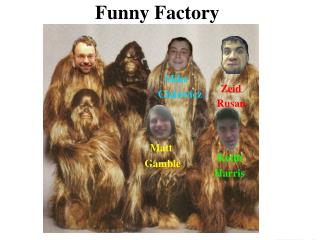
Funny Factory Mike Cialowicz Zeid Rusan Matt Gamble Keith Harris
Our Missions: 1- To explore strange new worlds. 2- Given an inputed sentence, output the statistically funniest response based on comedic data. Our Approach: 1- Learn from relationships between words in jokes. 2- Learn from sentence structures of jokes. “On Screen!”
Setup 1: “I feel bad going behind Lois' back.” Setup 2: “Don't feel bad Peter.” Zinger!: “Oh I never thought of it like that!” Step 1: Collect data (2.5 MB) . . . . . .
“I feel bad going behind Lois' back.” “Don't feel bad Peter.” /VB /NN /JJ /NNP “Oh I never thought of it like that!” /UH /PRP /RB /VBD /IN /PRP /IN /DT Step 2: Tag the jokes (Size = 3.5MB) /PRP /VBP /JJ /NN /IN /NNP /RB Attach: Attach: Attach: “Who tagged that there?”
I feel bad going behind Lois' back Step 3a: Zinger word counts(100 MB) For each word : Count! For word 'feel' : Intuition: Word relations in Zingers should help us construct our own!
Step 3b: Cross sentence counts (## MB) For each adjacent pair in setups : Don't feel bad Peter Oh I never thought of it like that! Count! : For 'feel,bad ' : Intuition: Words in input should help us place a seed word in Zingers we are constructing!
Oh I never thought of it like that! /UH /PRP /RB /VBD /IN /PRP /IN /DT Step 3c: Structure counts (2.2 MB) For each sentence : Count! : Intuition: Using known funny Zinger structures should yield funnier constructed Zingers.
Converted dictionary counts to probabilities using: Laplace smoothing (k = 1) Lidstone's law (k = 0.5, 0.05) Step 4: Smoothing! “Damn that's smooth”
This is an example sense makes sense /DT makes sense “This makes sense” Step 5: Make a sentence! Input sentence : Get seed word : Highest Prob Generate more words : Highest Prob Get a structure : Highest Prob Complete sentence : Highest Prob
Step 6: DEMO! 5/11/2006 @ 4:13 am in the Linux Lab “YEAH BOYYYYYYYY!”
- Incorporate semantics. - Collect MORE data. (Need a better computer) - Apply weights to cross sentence counts - Evaluate using test subjects (mainly Billy) with different combinations of weight and probability (k = #) parameters. - Do parameters converge along with funny? - Reevaluate using the (better?) parameters. Step 7: Future Work