Analysis of Viterbi Algorithm for Binary-input AWGN Channel and Performance Bounds
This document provides a detailed analysis of the Viterbi algorithm applied to binary-input Additive White Gaussian Noise (AWGN) channels. It discusses decoding techniques in low-capacity channels, focusing on decoding errors, channel capacity, and first-event error probabilities. Additionally, it presents performance implications of convolutional codes with varying rates and the significance of asymptotic coding gain. The document highlights metrics used to decode based on correlation and outlines criteria for optimal code design. Exercises to reinforce concepts are also included.

Analysis of Viterbi Algorithm for Binary-input AWGN Channel and Performance Bounds
E N D
Presentation Transcript
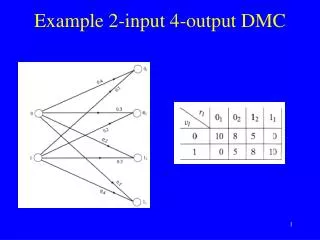
Example BSC • Transition probability 0.3’ • Recall: MLD decodes to closest codeword in Hamming distance • Note: extremely poor channel! • Channel capacity = 0.12
Example 1 3 2 4 4 4 5 4 6 5 7 4 5 2 5 3 4 2 3 6 6
The Viterbi algorithm for the binary-input AWGN channel • Recall from Chapter 10: • Metrics: Correlation • Decode to the codeword v whose correlation rv with r is maximum • Symbol metrics: rv
Performance bounds • Linear code, and symmetric DMC: • We can w. l. o. g. assume that the all zero codeword is transmitted • ..and that if we make a mistake, the wrong codeword is something else • Thus the decoding mistake will take place at the time instant in the trellis when the wrong codeword and the zero codeword merge • Therefore, interested in the elementary codewords (first event errors)
Performance bounds: BSC • Then the first-event error probability at time t is • Assume that the wrong codeword has weight d Pd: Channel specific
Simplifications of Pd B Pb (E)
Performance bounds: Binary-input AWGN • Asymptotic coding gain = 10 log 10 (Rdfree/2) • BSC derived from AWGN:
Pd for binary-input AWGN v correct: (-1,...,-1) v’ incorrect Sum of d ind.Gaussian random variables (-1,N0/2Es) Count only positions where v’ and v differ
Pd for binary-input AWGN • Asymptotic coding gain = 10 log 10 (Rdfree)
Rate 1/3 convolutional code 3.3 dB • = 10 log10 (1/3*7) = 3.68dB
Some further comments Replace this by a bound • Union bound poor for small SNR • Contributions from higher order terms becomes significant • When to stop the summation? • Other bounds: Divide summation in two parts near/far
Code design: Computer search • Criteria • High dfree • Low Adfree (Low Bdfree)? • High slope/low truncation length* • Use Viterbi algorithm to determine the weight properties • Example:
Example: Viterbi algorithm for distance properties calculation 3 4 6 5 7 6 8 7 5 7 6 7 7 7 7
Suggested exercises • 12.6-12.21