The Nitrogen Cycle
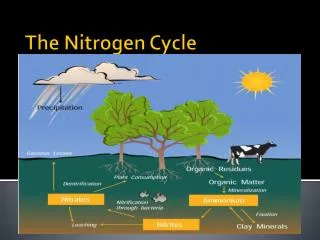
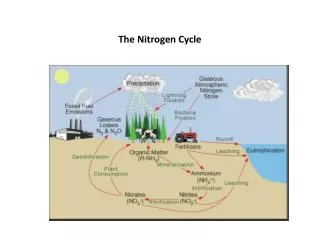
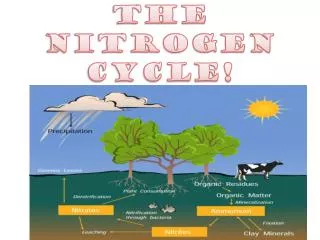
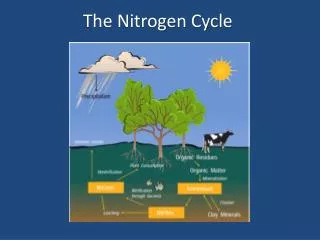
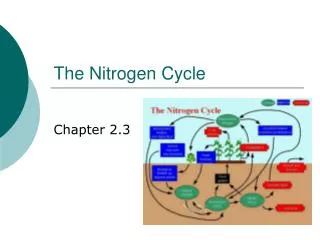
The nitrogen cycle is the essential process in which nitrogen (N2) is converted into various chemical forms that can be utilized by living organisms. Although nitrogen makes up 78-80% of Earth's atmosphere, it cannot be directly absorbed by plants. It must be 'fixed' by specialized bacteria like Rhizobium or through lightning. Decomposition of organic matter transforms nitrogen into ammonia (NH3), which then converts to nitrite (NO2-) and finally to nitrate (NO3-), a form usable by plants. Denitrification returns nitrogen to the atmosphere, completing the cycle.

The Nitrogen Cycle
E N D
Presentation Transcript
The Nitrogen Cycle • Is the process in which Nitrogen (N2) is converted between its various chemical forms.
The Nitrogen Cycle • Is the process in which Nitrogen (N2) is converted between its various chemical forms. • The majority of the Earth’s atmosphere (78-80%) is Nitrogen, however (like carbon) atmospheric Nitrogen cannot be used straight from the air – it must be passed through the Nitrogen cycle first!
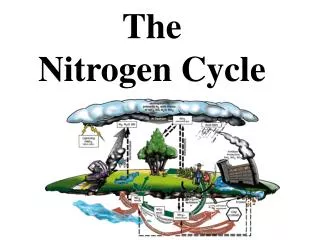
Why does it have to be cycled? • Atmospheric Nitrogen is mostly unusable by plants – Nitrogen needs to be ‘fixed’ in order to convert gaseous nitrogen into forms usable to plants.
Why does it have to be cycled? • Atmospheric Nitrogen is mostly unusable by plants – Nitrogen needs to be ‘fixed’ in order to convert gaseous nitrogen into forms usable to plants. • Some fixation of nitrogen occurs as lightning strikes, but most is converted by free-living or symbiotic bacteria. For example Rhizobium, which live in the root nodules of legumes.
Why does it have to be cycled? • Atmospheric Nitrogen is mostly unusable by plants – Nitrogen needs to be ‘fixed’ in order to convert gaseous nitrogen into forms usable to plants. • Some fixation of nitrogen occurs as lightning strikes, but most is converted by free-living or symbiotic bacteria. For example Rhizobium, which live in the root nodules of legumes. • This helps nutrient-poor soils become more enriched with Nitrogen.
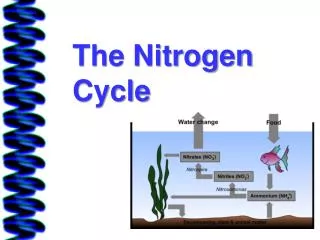
Other factors to the Nitrogen Cycle • When a plant or animal dies, the initial form of Nitrogen is organic. Bacteria (or sometimes fungi) convert the organic Nitrogen into ammonia (NH3).
Other factors to the Nitrogen Cycle • When a plant or animal dies, the initial form of Nitrogen is organic. Bacteria (or sometimes fungi) convert the organic Nitrogen into ammonia (NH3). • For ammonia to be converted to Nitrate, it needs to be converted to Nitrite (NO-2) first, and it does this through nitrifying bacteria. Now, Nitrate (NO-3) can be used by plants.
Other factors to the Nitrogen Cycle • When a plant or animal dies, the initial form of Nitrogen is organic. Bacteria (or sometimes fungi) convert the organic Nitrogen into ammonia (NH3). • For ammonia to be converted to Nitrate, it needs to be converted to Nitrite (NO-2) first, and it does this through nitrifying bacteria. Now, Nitrate (NO-3) can be used by plants. • Denitrification is the reduction of nitrates back into the largely inert nitrogen gas (N2), completing the nitrogen cycle. This process is performed by bacterial species.