The Grandfather Clock: The Pendulum
The Grandfather Clock: The Pendulum. By Pat Ryan and Kindra Fuller. Anchor. Amplitude. The angular displacement from its vertical or equilibrium position. It is measured in terms of the angle that it makes with the vertical. Frequency.

The Grandfather Clock: The Pendulum
E N D
Presentation Transcript
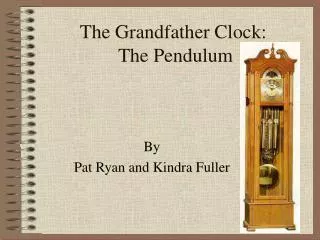
The Grandfather Clock: The Pendulum By Pat Ryan and Kindra Fuller
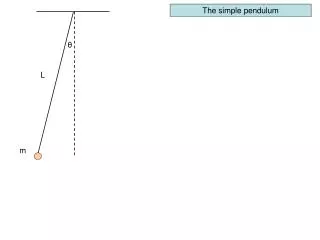
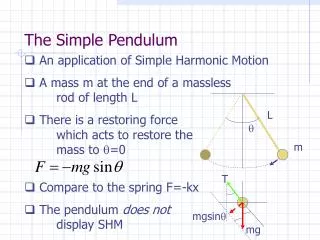
Amplitude • The angular displacement from its vertical or equilibrium position. It is measured in terms of the angle that it makes with the vertical.
Frequency • The number of cycles of a periodic process that occur per unit time (second). The unit of measure is the hertz (Hz).
Cycle • Cycle-one full motion from one amplitude position to the other and back again.
Period • Period-the time for one complete cycle of a periodic process and units are in seconds, minutes, etc.
Frequency Equation The equation to calculate the frequency of a pendulum is: f = (1/2pi) * sqrt(g/L) or f = (1/2π) * √(g/L)
Length of Pendulum If you wanted to find the length for a given frequency, you can write that equation as: L = g/(4*pi2*f2) or L = g/(4*π2*f2)
Determining the Period • When given the length of a pendulum, you can find its period by: T=2π√L/g T is the period and g is the acceleration due to gravity. (9.8 m/s2)
Gravity • Value of “g” is Not Constant • Denver Colorado (Mile High City) • On the Moon
1. What happens when you double the mass of the pendulum bob? • The pendulum swings twice as fast • The pendulum swings half as fast • The speed stays the same • 2. What happens if you decrease the length of the pendulum rod? • You decrease the amplitude of the swing • You increase the frequency or rate of the pendulum • You decrease the weight of the bob • 3. How does a pendulum on the Moon compare with one on Earth? • It doesn't work, because there is no air on the Moon • Its frequency would be slower because gravity (g) on the Moon is less than on Earth • Its frequency would be faster because gravity (g) on the Moon is more than on Earth
Sources • www.school-for-champions.com/science/pendulum.htm • www.howstuffworks.com/clock.htm • http//hyperphysics.phy-astr.gsu.edu/HBASE/pend.htmlwww.cpo.com/sc_pendulum.shtml