Understanding Orbits and Escape Velocity: Conic Sections and Gravity Assist
260 likes | 392 Views
Explore the fascinating world of orbits, which can be elliptical, parabolic, or hyperbolic. All orbit shapes are conic sections defined by their foci. Learn about escape velocity, the speed needed to break free from a celestial body's gravitational pull—11 km/sec for Earth. Discover how different velocities determine an object's orbit type and the role of gravity assists in space travel. These unique maneuvers can capture or eject comets, redirect spacecraft, and even dramatically reduce energy costs in missions, like Cassini's journey to Saturn.


Understanding Orbits and Escape Velocity: Conic Sections and Gravity Assist
E N D
Presentation Transcript
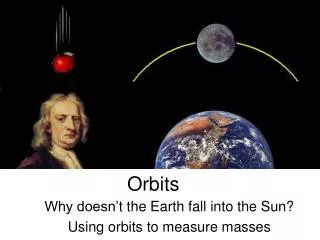
More About Orbits Orbits can be ellipses, parabolas or hyperbolas
Escape Velocity • Every object has an escape velocity • Anything launched with less than escape velocity will fall back • Anything launched with greater than escape velocity will keep going and never return • Escape velocity from Earth’s surface is 11 km/sec or 25,000 miles per hour. • For anything in a circular orbit, escape velocity is 1.4 times its orbital velocity.
Orbits and Escape Velocity • Anything moving with less than escape velocity will travel in an elliptical orbit • Anything moving exactly with escape velocity will travel in a parabolic orbit (Think of it as an infinitely long ellipse) • Anything moving with more than escape velocity will travel in a hyperbolic orbit
What About Three Objects? • Kepler and Newton solved the problem of one object orbiting about another • Are there formulas for three interacting bodies? • Bottom Line: No (After much effort) • Except for a few special cases...
Gravity Assist • Gravity assist happens naturally. It can capture comets into short-period orbits or expel them from the Solar System • We use gravity assist to speed up, slow down, or redirect spacecraft • The Cassini mission to Saturn was launched with only one-fifth the energy needed to reach Saturn
In Gravity Assist, a Massive Object Causes a less Massive One to Speed Up or Slow Down