Understanding Biotic Factors Impacting Populations in Ecosystems
Biotic factors are the living components of an ecosystem that influence populations and their dynamics. This includes elements like predation, competition, habitat destruction, poaching, pollution, disease, carrying capacity, and plant types. Predation occurs when one animal hunts another, affecting population numbers. Competition arises among species vying for limited resources. Additionally, human actions like habitat destruction and pollution significantly impact wildlife. This overview explores the six major biotic factors and their roles in maintaining ecological balance.

Understanding Biotic Factors Impacting Populations in Ecosystems
E N D
Presentation Transcript
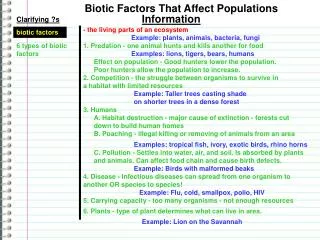
Biotic Factors That Affect Populations Information Clarifying ?s - the living parts of an ecosystem biotic factors Example: plants, animals, bacteria, fungi 6 types of biotic factors 1. Predation - one animal hunts and kills another for food Examples: lions, tigers, bears, humans Effect on population - Good hunters lower the population. Poor hunters allow the population to increase. 2. Competition - the struggle between organisms to survive in a habitat with limited resources Example: Taller trees casting shade on shorter trees in a dense forest 3. Humans A. Habitat destruction - major cause of extinction - forests cut down to build human homes B. Poaching - illegal killing or removing of animals from an area Examples: tropical fish, ivory, exotic birds, rhino horns C. Pollution - Settles into water, air, and soil. Is absorbed by plants and animals. Can affect food chain and cause birth defects. Example: Birds with malformed beaks 4. Disease - Infectious diseases can spread from one organism to another OR species to species! Example: Flu, cold, smallpox, polio, HIV 5. Carrying capacity - too many organisms - not enough resources 6. Plants - type of plant determines what can live in area. Example: Lion on the Savannah