Reflex Physiology
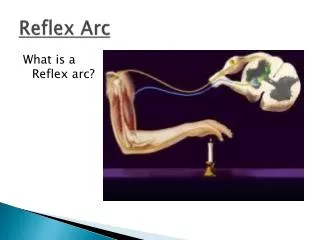
Reflex Physiology. Reflex Arc. The reflex arc governs the operation of reflexes. Nerve impulses follow nerve pathways as they travel through the nervous system. The simplest of these pathways, is called the reflex arc .

Reflex Physiology
E N D
Presentation Transcript
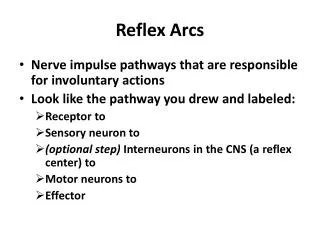
Reflex Arc • The reflex arc governs the operation of reflexes. • Nerve impulses follow nerve pathways as they travel through the nervous system. The simplest of these pathways, is called the reflex arc. • Reflexes whose arc passes through the spinal cord are called spinal reflexes.
Parts of the Reflex Arc • Receptor – detects the stimulus. a) Description: the receptor end of a particular dendrite or a receptor cell in a sensory organ. b) Function: sensitive to a specific type of internal or external change. • Sensory neuron – conveys the sensory info to brain or spinal cord. a) Description: Dendrite, cell body, and axon of a sensory neuron. b) Function: transmit nerve impulses from the receptor into the brain or spinal cord.
Parts of the Reflex Arc 3. Interneuron: relay neurons. a)Description: dendrite, cell body, and axon of a neuron within the brain or spinal cord. b) Function: serves as processing center, conducts nerve impulses from the sensory neuron to a motor neuron. 4. Motor neuron: conduct motor output to the periphery. a)Description: Dendrite, cell body, and axon of a motor neuron. b) Function: transmits nerve impulse from the brain or spinal cord out to an effecter.
Parts of the Reflex Arc 5. Effector: a)Description: a muscle or gland. b)Function: Response to stimulation by the motor neuron and produces the reflex or behavioral action.
Spinal Reflexes Reciprocal inhibition Contraction of one muscle set accompanied by relaxation of antagonist muscle • Flexor reflex: Complex reflex arc used to withdraw limb from aversive stimulus • Crossed-extensor reflex: Activation of extensor muscles and inhibition of flexors on opposite side
The Withdrawal Reflex (Flexor Reflex) • The automatic withdrawal of an extremity from a painful stimulus. • A polysynaptic reflex. • Sensory pain signals excite motor neurons to the flexor muscles, eliciting flexion and withdrawal of the leg. • Motor neurons to the extensor muscles are inhibited via inhibitory interneurons. • This would relax the extensors of the same leg.
The Crossed Extensor Reflex • A polysynaptic reflex. • E.g., Painful stimulation of one foot causes flexion (withdrawal) of the ipsilateral leg as well as the extension of the contralateral leg, to stabilize the posture.