Download
1 / 30
300 likes | 495 Views
Phases of Matter. Physical Properties. - characteristics of a substance that can be observed without changing the identity of the substance. It is still made of exactly the same substance. For example: 1. cutting wood – it’s still wood 2. Ice, water (liquid) & water vapor – still H 2 O.

E N D
Physical Properties • - characteristics of a substance that can be observed without changing the identity of the substance.
It is still made of exactly the same substance. • For example: • 1. cutting wood – it’s still wood • 2. Ice, water (liquid) & water vapor – still H2O
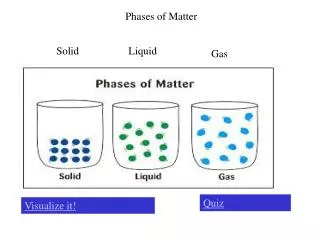
Phases of Matter • Matter can exist in 4 phases (states) • 1. solid • 2. liquid • 3. gas • 4. plasma
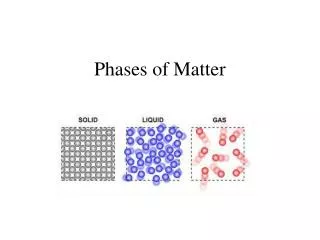
Solids • Two characteristics • 1. definite shape • 2. definite volume
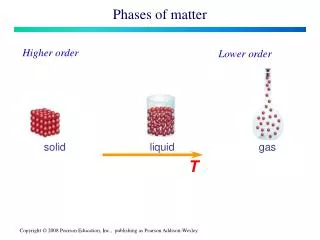
WHY??? • The tiny particles that make up a solid are packed closely together. The particles cannot move far from their places. Therefore it is able to keep a definite shape.
Two types of arrangements. • 1. Crystalline solids: particles inside arranged in a regular, repeating pattern called a crystal. • Keep a definite shape
Amorphous solids: particles inside are not in a pattern. • Lose their shapes under certain conditions. • Examples: tar, candle wax and window glass
Liquids • DO NOT have a definite shape, but DO have a definite volume. • Liquids take the shape of the container they are in. • 1 liter is still one liter no matter what you put in it.
Particles are close together, but not as close as in a solid. • Particles are free to move – they flow around each other.
Viscosity • The resistance of a liquid to flow. • This is why some liquids flow more easily than others.
Gases • No definite shape • No definite volume
Gases • Fill all available space in a container
Gases • The particles can spread far apart or be packed very close together. • Particles can easily move around each other. • Particles of a gas are in constant motion.
Pressure • The effect of the collisions of particles with the environment it is in. • More collisions = high pressure • Fewer collisions = low pressure
Boyle’s Law • Boyles Law is the relationship between volume and pressure. • Deals with pressure and volume only. • States that if the volume of the gas decreases, the pressure increases; or if the volume increases, the pressure decreases.
Charles’ Law • Deals with volume and temperature only • If the temperature increases, the volume increases.
Plasma • Very high temperature to form • Rare on Earth • Found only in the laboratory or in space.
Physical Change • A change of matter from one form to another without a change in chemical properties.
Examples: • Breaking a piece of chalk • Dissolving sugar • Melting ice • Mixing oil and vinegar
Physical changes do not change a substances identity. • Example: melting, freezing and evaporating.
Dissolving is a physical change. • Examples: sugar in water
Chemical Changes • A change that occurs when a substance changes composition by forming one or more new substances.
Examples of Chemical Changes • When a battery “dies” • When fruits and vegetables ripen • When you digest food • When you breathe oxygen
Chemical changes form new substances that have different properties. • Example: baking a cake
Chemical changes can be detected. • A change in color or odor • Fizzing or foaming • Production of sound, light or odor