Understanding Counting Techniques: Rules of Counting, Permutations, and Combinations
This guide delves into fundamental counting techniques essential for combinatorial mathematics. It begins with the Fundamental Rule of Counting, stating that if event A can occur in m distinct ways, and event B in n distinct ways, the total occurrences of both events are mn. It then explores permutations, where arrangement matters and no item duplicates are allowed, expressed as P(n, x) = n!/(n-x)!. Lastly, it discusses combinations, where arrangement does not affect outcomes, calculated as C(n, x) = n!/(x!(n-x)!). Master these concepts for effective problem-solving in combinatorics.

Understanding Counting Techniques: Rules of Counting, Permutations, and Combinations
E N D
Presentation Transcript
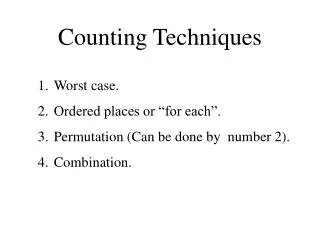
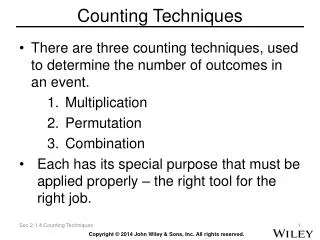
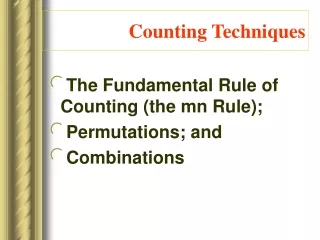
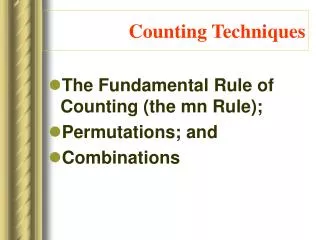
Counting Techniques • The Fundamental Rule of Counting (the mn Rule); • Permutations; and • Combinations
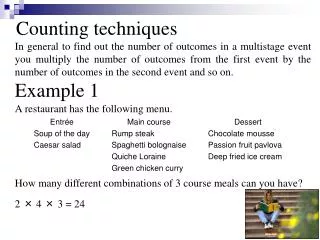
The Fundamental Rule of Counting If event A can occur in mdistinct ways and event B can occur in any of ndistinct ways (regardless of how event A occurs), then event A and event B can occur in mn ways.
Permutations When different arrangements count as distinct outcomes but duplication of items is not allowed, then Permutations is the counting procedure for the arrangement of items. If there are n items and each item can occur x different ways, then Number of ways = Pnx = (n!) / (n - x)!
Combinations When different arrangements do not count as distinct outcomes and duplication of items is not allowed, then Combinations is the counting procedure for the arrangement of items. If there are n items and each item can occur x different ways, then Number of ways = Cnx = (n!) / x!(n - x)!