Download
1 / 17
170 likes | 376 Views
Explore BVOC emission patterns at the Amazonian Tall Tower Observatory in relation to various environmental factors, highlighting distinct emission capacities and seasonal variations. Gain valuable insights into the intricate forest-atmosphere interactions in the iconic Amazon Rainforest.

E N D
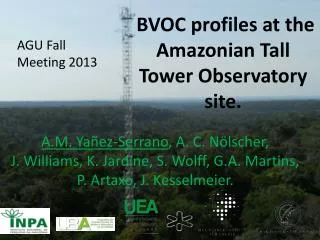
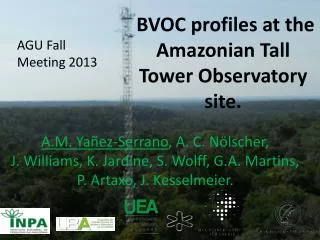
AGU Fall Meeting 2013 BVOC profiles at the Amazonian Tall Tower Observatory site. A.M. Yañez-Serrano, A. C. Nölscher, J. Williams, K. Jardine, S. Wolff, G.A. Martins, P. Artaxo, J. Kesselmeier.
The Amazon Rainforest • Tropical photoreactor • High temperatures • High solar radiation • High humidity • High forest-atmosphere interactions • There is a strong coupling between the atmosphere and the biosphere via the hydrological cycle, radiation balance and nutrient cycles among others. • The Amazon is 50% of the world’s tropical rainforest – High density of biomass
Radiative Properties Ozone CO CH4 Condensable vapours Secondary Organic aerosol Organic Aerosol CCN • Oxidation • OH • O3 • NO3 rain Isoprene Monoterpenes Oxygenated VOC Other BVOC VOCs + NOx BVOC from vegetation BVOC from soil
ATTO: Amazonian Tall Tower Observatory 150 km NE of Manaus • Negligible influence from Manaus plume • Logistically viable Temperature 24-34ºC Main wind direct. NE Ozone 2-30 ppbV NO 0,3-0,7 ppbV S 02°08’38.8” W 58°59’59.5”
Sampling methodology 79m • Insulated heated Teflon lines • Flushing at all times 53m The 38m 24m 12m container 4m 0,5m 0,05m
PTR-MS Proton Transfer ReactionMassSpectrometer • Measures online VOCs at lowconcentrations. • Softchemicalionizationtechnique • Sampleisprotonized and massspectrometerdetectsselectedmasses +1.
Time of measurements Calibrated Compounds • February/March 2013 – WET SEASON • September 2013 - DRY SEASON
Isoprene – Monoterpene comparison to light and temperature driven emission algorithms
Conclusions • Patterns of isoprene and monoterpene concentrations seem to differ in relation to their emission capacities as indicated by emission algorithms. • May monoterpeneconcentrations partly be influenced by release from storage pools triggered by temperature only? • It seems that for late September 2013 the understory was more active than the top of the canopy for some compounds. • Isoprene oxidation products are directly related to the isoprene concentrations during the wet season. • Possible direct plant emission during the dry season as well? • Oxygenated compounds seem to be related to sources of both photochemical and biological origin, differing among seasons.