Download
1 / 23
230 likes | 379 Views
This guide outlines good practices for Working Groups (WGs) to improve their functioning, harmonize with the implementation of PARPA, and enhance sector policy dialogues. It emphasizes the importance of organization, planning, and effective communication among members from Government and donor agencies. Key recommendations include establishing clear terms of reference, promoting joint analytical work, and ensuring active engagement from all stakeholders. The guide serves as a resource for HOCs and donors to strengthen collaboration and avoid duplication of efforts within sector WGs.

E N D
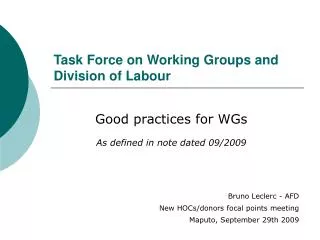
Task Force on Working Groups and Division of Labour Good practices for WGs As defined in note dated 09/2009 Bruno Leclerc - AFD New HOCs/donors focal points meeting Maputo, September 29th 2009
Good Practices for WGsSummary • Introduction : usual practices • Objectives • Guiding Principles • Good practices for WGs • to improve the functioning of the Group (organization, methods planning) • to strenghten harmonization with PARPA implementation • What the HoCs should do in general • What the HOCs whose institution is chairing a WG should do • What the TF on WGs/DoL should do
Good Practices for WGsI. - Introduction : usual practice • A sector WG includes members from both GoM and donors • A sector WG is chaired by GoM • Donors appoint a donor focal point • Different levels of meetings : Minister, directorates, departments • Donors-only meetings to prepare meetings with GoM and positions • In some cases, sub WGs
Good Practices for WGsII. - Objectives - III - guiding principles II. Objectives • improve quality of partners contributions to the sector policy dialogue • increase efficiency, with a more result-oriented approach • increase consistency across sectors III. Guiding Principles a) In general • avoidmultiplication of groups and sub-groups • strive for consistency and stability within groups • consider more systematically involving civil society b) For donors • Be more active in less WGs
Good Practices for WGsIV - Good practices IV.1.1 To improve functioning in terms of organization a) In general • temporary task forces for specific issues • do not rule out donors who are not financing the sector directly • Technical Assistants may participate as resource persons b) For donors • promote system of troika or chair/vice-chair • identify core group of active members • distribution of members in active, attending, informed
Good Practices for WGsIV - Good practices IV.1.2 To improve functioning in terms of methods a) In general • clear ToRs (objectives, organization etc.) • annual result oriented working plan (responsibilities, calendar, outputs) • annual reports against annual working plans • joint analytical works • joint field visits • joint mapping of GoM/donors activities in the sector • planning of the agendas of the WG meetings • use the Joint Review to strengthen the dialogue with GoM b) For donors • make the WG work between the JRs • contract out consultants or young professionals • promote joint supervision HQs missions among donors • use the PAPs website to share information • careful in the use of email
Good Practices for WGsIV - Good practices IV.1.3 To improve functioning in terms of planning • balanced number of focal points by donors • general principle (with flexibility): • troika for bigger WGs, • focal point and co-focal point for others • focal points are decided by WG members • have at least a 2 year planning of the focal points • flexibility is accepted in the 2 year planning • duration of chair is flexible (1 year or more) • if 2 years chair, discussion on collective assessment of the focal donor performance is advised after the 1° year • rotation of focal points would be around the JR (04-05)
Good Practices for WGsIV - Good practices IV.2. Good practices for WGs to strenghten harmonisation with PARPA implementation a) In general • improve the coordination between WGs (include economists in the main WGs) • have a specific focus on capacity development b) For donors • nominate members of the donors-only WG to participate in other sector WGs • improve harmonization between sector MoUs and GBS MoU, link with PAPs PAF targets
Good Practices for WGsV and VI - What the HOCs should do V. What the HoCs should do in general • identify gaps and duplication across sector WGs • ensure a better distribution of staff among WGs • ensure a better division of labour inside their organization VI. What the HoCs whose institution is focal donor should do • have close contacts with the GoM chair of the WG (incl. Minister) • invest time in building relationship • focus on system strenghtening and results to achieve • increase the link between HoCs and sector coordinators/specialists • participate to WG meetings when necessary • organize periodic meetings with donors WG members and HoCs • develop discussions on issues of cross-sectorial importance
Good Practices for WGsVII - What the TF on WGs-DoL should do • link and work with GoM • stimulate the implementation of the note on good practices for WGs • disseminate the good practices among donors • update regularly the mapping on WGs • Prepare annual action plans of the TF and report regularly to G19/DPG • Organize short information sessions on the good practices for new focal points and new HOCs in June-September
Good Practices for WGsIssues for discussion • attending members. Do we agree? • streamlining WGs architecture. How? • Responsibilities of donor focal points. Too much? Not enough? • Responsibilities of HOCs. Too much? Not enough? • Training on how to manage a meeting. Would it be useful? When?