Download

1 / 11
130 likes | 281 Views
This comprehensive overview delves into the intricate landscape of Europe during the interwar years following World War I. It examines the repercussions of the Treaty of Versailles, the rise of fascism amid economic turmoil, and the responses of major powers like Germany, France, and Great Britain. Highlights include the impact of the Great Depression, social tensions, and the rise of new political ideologies. The text also discusses colonial movements and international relations, showcasing the struggle between recovery and instability in a changing world.

E N D
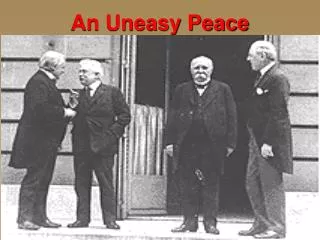
An Uncertain Peace U14: Anxiety & Interwar Years AP European History Ms. Tully - UHS
A. WWI Aftermath • GR - hated ToV • FR – isolated and fearful • US – isolationist • RS – hostile, communist • 1920s = recovery and democracy • 1930s – depression and fascism • Burial of an Unknown Soldier • “Lost Generation”
B. Germany and the Western Powers, 1919-1924 • League of Nations undermined • GR hated treaty • FR – implement treaty, reparations • BR – softer position on GR; need for markets • John Maynard Keynes – British economist
6. France & the “Little Entente” 7. Allied Reparations Committee – 132 billion marks ($33 billion), annual installments of 2.5 billion 8. The “Ruhr Crisis” (Jan. 1923) 9. GR Hyperinflation & passive resistance 10. Social tensions in GR 11. Compromise
C. The Hopeful Years(1924-1929) • Gustav Streseman – stabilized GR • Dawes Plan (1924) • Treaty of Locarno (1925) • Kellogg-Briad Pact (1928)
D. The Great Depression • Two major factors: downturn in domestic economies & collapse of US stock market • Surplus of wheat – sharp decline in price • Protectionism & Trade Barriers • Prosperity of 1920s dependent on US bank loans • Vienna bank Credit-Anstalt collapsed May 1931 • Cutting back on production = largescale unemployment • Govt’s unable to deal with crises – classical liberalism didn’t work • Renewed interest in Marxism • New authoritarian movement = fascism
E. Great Britain • Lost markets for industrial production during WWI • Rise in unemployment – 2 million by 1921 • Conservative gov’t under Stanley Baldwin led recovery of 1920s • General Strike of 1926 • National Gov’t brought Britain out of GD
F. France • Strongest country on continent after WWI • National Bloc gov’t – Raymond Poincare • Cartel of the Left gov’t – antimilitarism, anticlericalism, education • Poincare is back! Brought stability 1926-1929 • Great Depression, Gov’t turmoil, rising Fascism • Popular Front of 1936 – French New Deal • French gov’t weak and vulnerable in 1938
G. The Scandinavian States • Successful recovery from GD • Social Democratic gov’t – rural and industrial cooperatives • Expanded social services • High taxes & large bureaucracies
H. The Colonial Empires • FR & BR acquired GR colonies • WWI led to movements for change in colonies • Saudi Arabia, Iraq gained independence • Mohandas Gandhi (1869-1948) & civil disobedience in India • 1935 – India granted internal self-gov’t
6. Africans attracted to nationalism 7. 1930s – African leaders calling for independence 8. Most colonies would not gain independence until after WWII