Automated Parser Generation (via CUP )
260 likes | 465 Views
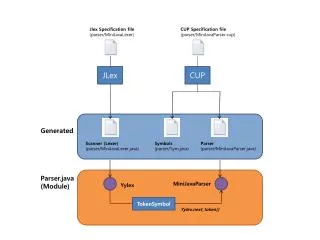
Automated Parser Generation (via CUP ). High-level structure. text. Lexer spec. .java. Lexical analyzer. JFlex. javac. Lexer.java. TPL.lex. (Token.java). tokens. Parser spec. .java. Parser. CUP. javac. sym.java Parser.java. TPL.cup. AST. Expression calculator.


Automated Parser Generation (via CUP )
E N D
Presentation Transcript
High-level structure text Lexerspec .java Lexical analyzer JFlex javac Lexer.java TPL.lex (Token.java) tokens Parserspec .java Parser CUP javac sym.javaParser.java TPL.cup AST
Expression calculator exprexpr + expr | expr - expr | expr * expr | expr / expr | - expr | ( expr ) | number • Goals of expression calculator parser: • Is 2+3+4+5 a valid expression? • What is the meaning (value) of this expression?
Syntax analysis with CUP • CUP – parser generator • Generates an LALR(1) Parser • Input: spec file • Output: a syntax analyzer tokens Parserspec .java Parser CUP javac AST
CUP spec file • Package and import specifications • User code components • Symbol (terminal and non-terminal) lists • Terminals go to sym.java • Types of AST nodes • Precedence declarations • The grammar • Semantic actions to construct AST
Symbol typeexplained later Expression Calculator – 1st Attempt terminal Integer NUMBER; terminal PLUS, MINUS, MULT, DIV; terminal LPAREN, RPAREN; non terminal Integer expr; expr ::= expr PLUS expr | expr MINUS expr | expr MULT expr | expr DIV expr | MINUS expr | LPAREN expr RPAREN | NUMBER ;
+ * + + + + * + a a a a b b c c b b c c Ambiguities a * b + c a + b + c
+ * + + + + * + a a a a b b c c b b c c Ambiguities as conflicts for LR(1) a * b + c a + b + c
Increasing precedence Expression Calculator – 2nd Attempt terminal Integer NUMBER; terminal PLUS,MINUS,MULT,DIV; terminal LPAREN, RPAREN; terminal UMINUS; non terminal Integer expr; precedence left PLUS, MINUS; precedence left DIV, MULT; precedence left UMINUS; expr ::= expr PLUS expr | expr MINUS expr | expr MULT expr | expr DIV expr | MINUS expr %prec UMINUS | LPAREN expr RPAREN | NUMBER ; Contextual precedence
Parsing ambiguous grammars using precedence declarations • Each terminal assigned with precedence • By default all terminals have lowest precedence • User can assign his own precedence • CUP assigns each production a precedence • Precedence of rightmost terminal in production • or user-specified contextual precedence • On shift/reduce conflict resolve ambiguity by comparing precedence of terminal and production and decides whether to shift or reduce • In case of equal precedencesleft/right help resolve conflicts • left means reduce • right means shift • More information on precedence declarations in CUP’s manual
+ + + + a a b c b c Resolving ambiguity precedence left PLUS a + b + c
* + + * a a b c b c Resolving ambiguity precedence left PLUSprecedence left MULT a * b + c
Resolving ambiguity precedence left MULTMINUS expr%prec UMINUS * - * - b a b a - a * b
Resolving ambiguity terminal Integer NUMBER; terminal PLUS,MINUS,MULT,DIV; terminal LPAREN, RPAREN; terminal UMINUS; precedence left PLUS, MINUS; precedence left DIV, MULT; precedence left UMINUS; expr ::= expr PLUS expr | expr MINUS expr | expr MULT expr | expr DIV expr | MINUS expr %prec UMINUS | LPAREN expr RPAREN | NUMBER ; UMINUS never returnedby scanner(used only to define precedence) Rule has precedence of UMINUS
More CUP directives • precedence nonassoc NEQ • Non-associative operators: < > == != etc. • 1<2<3 identified as an error (semantic error?) • start non-terminal • Specifies start non-terminal other than first non-terminal • Can change to test parts of grammar • Getting internal representation • Command line options: • -dump_grammar • -dump_states • -dump_tables • -dump
Generated from tokendeclarations in .cup file Scanner integration import java_cup.runtime.*; %% %cup %eofval{ return new Symbol(sym.EOF); %eofval} NUMBER=[0-9]+ %% <YYINITIAL>”+” { return new Symbol(sym.PLUS); } <YYINITIAL>”-” { return new Symbol(sym.MINUS); } <YYINITIAL>”*” { return new Symbol(sym.MULT); } <YYINITIAL>”/” { return new Symbol(sym.DIV); } <YYINITIAL>”(” { return new Symbol(sym.LPAREN); } <YYINITIAL>”)” { return new Symbol(sym.RPAREN); } <YYINITIAL>{NUMBER} { return new Symbol(sym.NUMBER, new Integer(yytext())); } <YYINITIAL>\n { } <YYINITIAL>. { } Parser gets terminals from the scanner
Recap • Package and import specifications and user code components • Symbol (terminal and non-terminal) lists • Define building-blocks of the grammar • Precedence declarations • May help resolve conflicts • The grammar • May introduce conflicts that have to be resolved
Assigning meaning • So far, only validation • Add Java code implementing semantic actions expr ::= expr PLUS expr | expr MINUS expr | expr MULT expr | expr DIV expr | MINUS expr %prec UMINUS | LPAREN expr RPAREN | NUMBER ;
Assigning meaning • Symbol labels used to name variables • RESULT names the left-hand side symbol expr ::= expr:e1 PLUS expr:e2 {: RESULT = new Integer(e1.intValue() + e2.intValue()); :} | expr:e1 MINUS expr:e2 {: RESULT = new Integer(e1.intValue() - e2.intValue()); :} | expr:e1 MULT expr:e2 {: RESULT = new Integer(e1.intValue() * e2.intValue()); :} | expr:e1 DIV expr:e2 {: RESULT = new Integer(e1.intValue() / e2.intValue()); :} | MINUS expr:e1 {: RESULT = new Integer(0 - e1.intValue(); :} %prec UMINUS | LPAREN expr:e1 RPAREN {: RESULT = e1; :} | NUMBER:n {: RESULT = n; :} ;
Building an AST • More useful representation of syntax tree • Less clutter • Actual level of detail depends on your design • Basis for semantic analysis • Later annotated with various information • Type information • Computed values • Technically – a class hierarchy of abstract syntax tree nodes
Parse tree vs. AST expr + expr + expr expr expr 1 + ( 2 ) + ( 3 ) 1 2 3
AST hierarchy example expr int_const plus minus times divide
AST construction • AST Nodes constructed during parsing • Stored in push-down stack • Bottom-up parser • Grammar rules annotated with actions for AST construction • When node is constructed all children available (already constructed) • Node (RESULT) pushed on stack • Top-down parser • More complicated
int_const int_const int_const val = 3 val = 2 val = 1 plus plus e1 e1 e2 e2 AST construction expr ::= expr:e1 PLUS expr:e2 {: RESULT = new plus(e1,e2); :} | LPAREN expr:e RPAREN {: RESULT = e; :} | INT_CONST:i {: RESULT = new int_const(…, i); :} 1 + (2) + (3) expr + (2) + (3) expr + (expr) + (3) expr + (3) expr + (expr) expr expr expr expr expr expr 1 + ( 2 ) + ( 3 )
Example of lists terminal Integer NUMBER; terminal PLUS,MINUS,MULT,DIV,LPAREN,RPAREN,SEMI; terminal UMINUS; non terminal Integer expr; non terminal expr_list, expr_part; precedence left PLUS, MINUS; precedence left DIV, MULT; precedence left UMINUS; expr_list ::= expr_list expr_part | expr_part ; expr_part ::= expr:e {: System.out.println("= " + e); :} SEMI ; expr ::= expr PLUS expr | expr MINUS expr | expr MULT expr | expr DIV expr | MINUS expr %prec UMINUS | LPAREN expr RPAREN | NUMBER ;