Understanding Atmospheric Measurement Instruments and Their Role in Weather Prediction
Atmospheric scientists utilize numerous instruments to study and forecast ever-changing atmospheric conditions. Key measurements include temperature, relative humidity, air pressure, wind direction, wind speed, and rainfall. Instruments like thermometers, hygrometers, barometers, weather vanes, anemometers, rain gauges, radiosondes, and satellites enable precise data collection. Earth's ability to maintain relatively stable temperatures despite solar heat and the relationship between air temperature, density, and pressure are crucial in understanding air movement and weather phenomena.


Understanding Atmospheric Measurement Instruments and Their Role in Weather Prediction
E N D
Presentation Transcript
Chp 11.2 NOTES Studying States of the Atmosphere
MAIN IDEA #1 Atmospheric scientists use a large variety of instruments to help us study and predict atmospheric conditions that are constantly changing hourly, daily, yearly…..
(Atmospheric) Measurements & Instruments Temperature Define:A degree of hotness or coldness measured on a definite scale. Instrument: Thermometer
Relative Humidity Define:Ratio of water vapor actually in the air compared to the maximum water vapor amount That the air can hold at a given temperature.
Instruments: hygrometer or psychrometer Use (of a psychrometer): 2 thermometers- 1 w/ a wet bulb, 1 w/ a dry bulb. Spin together in air, compare. The greater the temp. differences, the less humid the air is. Put wet gauze on end of bulb.
AIR PRESSURE Define:The force with which air pushes down on Earth. Instruments: Barometer
WIND DIRECTION INSTRUMENTS:weather vane, wind sock
Rainfall Amount INSTRUMENTS:rain gauge.
Wind Speed INSTRUMENTS:anemometer, wind sock
Upper atmosphere INSTRUMENTS:radiosondes, satellites, radar
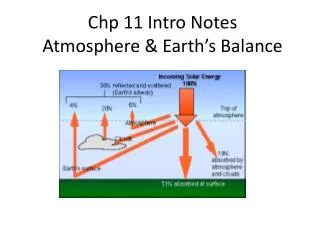
MAIN IDEA #2 Earth is able to maintain relatively stable temperatures, even w/ the large amount of heat energy sent from the sun.
Main Idea 3: Air temp & density directly affect pressure. These Pressure differences lead to air movement.