Download
1 / 1
10 likes | 123 Views
The E ffects of Efficacy P erceptions and Poverty Attributions o n P ublic S upport for Development A id Gregory D. B. Boese 1 and Bobbie N. J. Macdonald 2 1 Simon Fraser University 2 London School of Economics and Political Science.

E N D
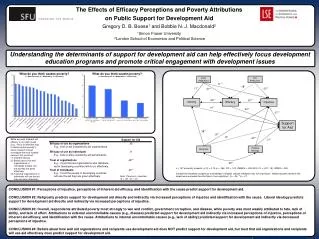
The Effects of Efficacy Perceptions and Poverty Attributions on Public Support for Development Aid Gregory D. B. Boese1and Bobbie N. J. Macdonald2 1Simon Fraser University 2London School of Economics and Political Science Understanding the determinants of support for development aid can help effectively focus development education programs and promote critical engagement with development issues While we used ‘inherent aid efficacy’ in our path model (e.g., “Aid is an effective way to reduce global poverty“), future research should investigate the multi-faceted nature of this construct: Inherent efficacy Beliefs about how well organizations or individuals actually use the aid they are given effectively. Trust that organizations or individuals will use the aid they are given effectively. n = 157 university students; χ2(3) = 3.70, p = .296, CFI = 1.00, RMSEA = .039 (90% CI: < .001, .15), SRMR = .025. Dashed lines between exogenous and mediator variables indicate mediation was non-significant. Additional paths tested in the model were excluded from the figure if non-significant. *p < .05, **p < .01 Note: Pearson’s r reported. *p < .05, **p < .01 CONCLUSION #1: Perceptions of injustice, perceptions of inherent aid efficacy, and identification with the cause predict support for development aid. CONCLUSION #2: Religiosity predicts support for development aid directly and indirectly via increased perceptions of injustice and identification with the cause. Liberal ideology predicts support for development aid directly and indirectly via increased perceptions of injustice. CONCLUSION #3: Overall, respondents attributed poverty most strongly to war and conflict, government corruption, and disease, while poverty was most weakly attributed to fate, lack of ability, and lack of effort.Attributions to external uncontrollable causes (e.g., disease) predicted support for development aid indirectly via increased perceptions of injustice, perceptions of inherent aid efficacy, and identification with the cause. Attributions to internal uncontrollable causes (e.g., lack of ability) predicted support for development aid indirectly via decreased perceptions of injustice. CONCLUSION #4: Beliefs about how well aid organizations and recipients use development aid does NOT predict support for development aid, but trust that aid organizations and recipients will use aid effectively does predict support for development aid.