Download

1 / 7
70 likes | 198 Views
Simple Harmonic Motion (SHM) describes the periodic vibration of a mass attached to a spring, oscillating consistently around an equilibrium position. The time taken for each complete cycle remains constant, indicating a regular and repeated motion. This motion relies on a restoring force that acts opposite to the displacement, attempting to return the object to its equilibrium state. Examples include a mass-spring system and a frictionless pendulum. Understanding SHM is essential in physics, showcasing fundamental oscillatory movements found in various systems.

E N D
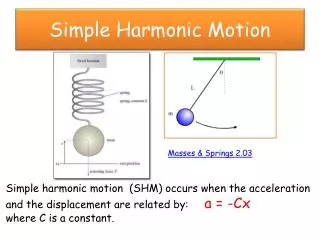
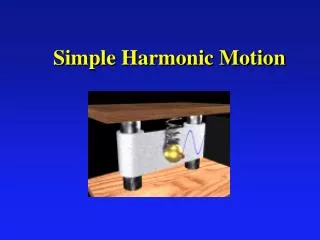
Consider a mass on the end of a spring • If the mass were to vibrate up and down, the object would be vibrating in the same path over and over again. • The mass on the spring not only repeats the same motion, it does so in a regular fashion. The time it takes to complete one back and forth cycle is always the same amount of time. If it takes the mass 3.2 seconds for the mass to complete the first back and forth cycle, then it will take 3.2 seconds to complete the seventh back and forth cycle
If a motion is regular and repeating it is called SIMPLE HARMONIC MOTION
Restoring Force • The restoring force is the force acting opposite of the displacement to move the object back it its equilibrium • Imagine a horizontal spring. If you applied a force and pulled the spring to a position x. The spring will be applying a force in the opposite direction in your hand. The opposite force wants to try restore the spring to its equilibrium. Therefore it is called the restoring force
The restoring force will always act in the opposite direction of the displacement
Examples of Simple Harmonic Motion • Horizontal Mass-spring system • Let’s look at figure 7.19 as an example
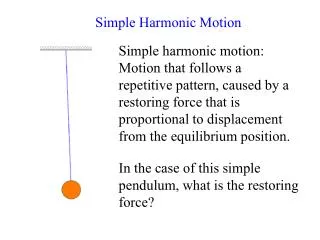
Pendulum • We assume that the system will be frictionless and that the entire mass of the pendulum is concentrated in the weight • Look at figure 7.26 as an example