
Exploring the Night Sky: A Journey through Celestial Beauty and Applications
E N D
Presentation Transcript
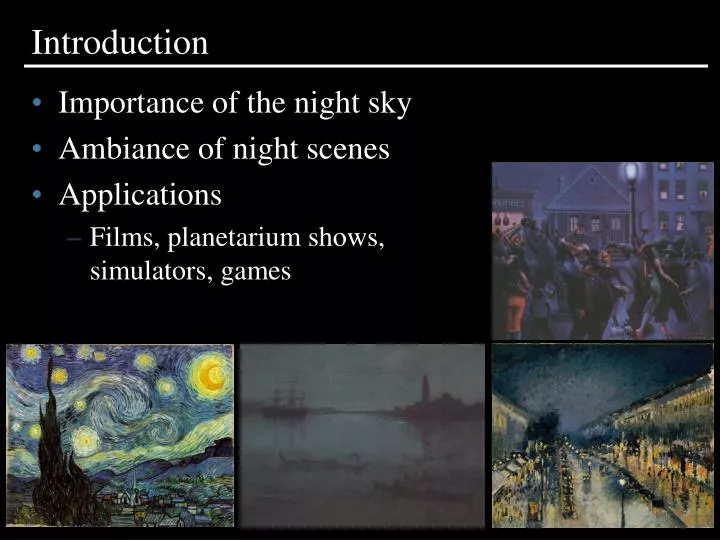
Introduction • Importance of the night sky • Ambiance of night scenes • Applications • Films, planetarium shows, simulators, games
Sun 103 Moon 10-3 Stars 10-8 Zodiacal light 10-7 Airglow 10-8 Cosmic light 10-10 Dim misc. 10 -8 10-9 Sources of Illumination (W/m2)
Moon Position • ~ 59% of the Moon is visible from the Earth • Rotates around itself at the same speed as around the Earth • Elliptical orbit
Modeling the Moon Data from the Clementine project • Geometric model • Albedo map • Elevation map • Illuminated by • Sun (black body) • Earth (earthshine) • Specialized BRDF
BRDF of the Moon • Low albedo (7%) • Reddish color • Backscattering (much brighter at full moon) • No limb darkening (uniform disc at full moon) • Constant across the surface • We decouple BRDF, spectral properties and albedo Photo by Antonio Cidadao