Download
1 / 80
800 likes | 907 Views
Explore the fundamental concepts of fluids and electrolytes for optimal health and balance. Learn about body fluid compartments, hydration, causes of dehydration, electrolytes, and osmosis. Gain insights into cellular environments and balanced maintenance.

E N D
Fluids and Electrolytes Staying Balanced Spring 2008
Water – H2O • “Universal solvent” • 60% of body’s weight • Cells “haf to have it.” • –Arnold Schwarzenegger
How much is that? • 154# person x .60 (60%) = • 92# • Water is approx 8# per gallon • 11 ½ gallons water • (Obese people/ less) • (Thin people/ more) • Infants • Elders
Basic Cellular Review • The fundamental unit • Requires: • Cell membrane • Enzymes • Internal membranes • Genetic material
Basic tissue types • Epithelial • Connective • Muscle • Nervous
The cellular environment • All metabolic reactions occur • The precise regulation of volume and composition of body fluid is essential to health.
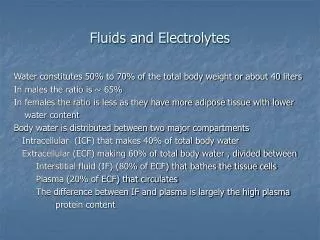
Body fluid compartments • Intracellular Fluid - ICF • Extracellular Fluid – ECF • Intravascular Fluid- Plasma • Interstitial Fluid
Intracellular - ICF • Fluid in all body cells • 75% of the water (60%) • 31.50 L (70 kg adult) • 40% of total body weight
Extracellular - ECF • 20% of water (60%) • 10.50 L (70 kg adult)) • Includes intravascular and interstitial compartments
ECF • Intravascular • 4% of (60%) • 7.5 L
ECF • Interstitial • 16% of (60%) • 17.5 L • Fluid between cells and outside the vascular bed • Connective tissue, cartilage, bone, CSF, intraocular fluid
Hydration • Water – Universal Solvent • Intake & Output (I&O)
Hydration • Homeostasis • The body’s need for balance
Aging and distribution of fluids • Newborns – TBW ~ 80% • Children – TBW ~ 60-65% • Elders – TBW < ~ 60%
Intake vs Output • Food - 1200 ml • Drink - 1000 ml • Metabolic sources - 300 ml = 2,500 ml • Lungs - 400 ml • Kidneys - 1500 ml • Skin - 400 ml • Intestine (Feces) - 200 ml = 2,500 ml
Hydration • Osmoreceptors - anterior hypothalamus • Baroreceptors - carotid sinus, aortic arch, kidneys • High and low blood pressure
Hydration • Anti-diuretic hormone (ADH) • If tide goes out • Pituitary Gland Excretes • Tide comes in!!! • Re-absorb from kidneys • Decrease urine • Thirst also regulates
Dehydration • Abnormal decrease in TBW • Thus the weigh-in at fires • Rarely involves only water loss • Electrolyte loss
Dehydration Causes • Signs and symptoms? • Treatment?
Causes of dehydration • GI losses • N/V/D • Insensible losses • Normal losses + with fever • Hyperventilation • High Environmental Temps • Increased sweating
Causes Of Dehydration • Internal losses • “Third” spacing • Peritonitis • Pancreatitis • Malnourished • No protein to retain water
Causes of Dehydration • Plasma Losses • Burns • Surgical Drains • Open Wounds
Signs And Symptoms • Signs of shock • Skin changes (turgor) • Orthostatic hypotension • Thirst • Increased pulse rate • Furrowed tongue
S/S, cont. • Decreased BP • Dry mucosa • Infants: Anterior fontanelle sunken • Dry diapers • Absent tears • Cap refill > 2 seconds • Dry mucosa
Treatment • O2 • ABCs • Fluids • Flavor? • Consider PASG • ECG
Overhydration – “No thanks I’m full.” • Edema • Peripheral vs. central (more later…) • Aggressive treatment if Pulmonary Edema
Overhydration • ABCs • O2 • Consider ETT • Meds: • NTG. • Lasix • M.S.
Fluid & Electrolyte Disturbances • Medical causes • Diabetes • Heat Emergencies • Blood Loss • Traumatic causes • Blood loss
Electrolytes • In H2O dissociate into ions • Cations = positive • Anions = negative
Principle CationsSodium-Potassium Pump • Sodium (Na+) • Prevalent in ECF • “Water follows it” • Nerve impulses • Hyper/ • Hyponatremia • Potassium (K+) • Prevalent in ICF • Nerve impulses • Hypo/ • Hyperkalemia
Other Cations • Calcium (Ca++) • Prevalent in ICF • Muscle contraction • Nerve impulse • Hypo/hypercalcemia
Other Cations • Magnesium (Mg++) • Present in ICF • Necessary for many processes • Found in some: • Antacids • Laxatives • Most associated with phosphate • Renal Functions
Principal Anions • Chloride (Cl-) • Present in ECF • Balances cations • Fluid balance • Renal function • Usually found hanging around sodium
Principal Anions • Bicarbonate (HCO3-) • Found in ECF • The Buffer • Neutralizes Acidic (H+) • Tx for acidosis
Anions • Phosphate (HPO4--) • Found in ICF - buffer • Energy stores • Mg++ in renal function
Electrolytes - mEq/L • Non-Electrolytes - • Glucose • Urea • Proteins
How does it get there? • Osmosis • Diffusion • Active Transport • Facilitated Diffusion
Isotonic • Hypertonic • Hypotonic • Osomotic gradient - difference in concentration
Osmosis • Movement of water (solvent) • Semi-permeable membrane • Towards highersoluteconcentration
Diffusion • Movement of solutes • Across membrane • Towards lesser solute concentration
Active transport • Movement of solutes • Across membrane • Against osmotic gradient • Requires energy (ATP) • Sodium-potassium pump
Facilitated diffusion • Helper proteins • Insulin • Open gate • Glucose
Osmotic Pressure • Governs movement of water and solutes across cell membrane • Pressure exerted by concentration of solutes • Pulls from other side of membrane
Blood Plasma • Colloid osmotic pressure • Plasma • Hydrostatic pressure • Blood pressure • Filtration
Edema • Localized • Site of injury • Organ systems - brain, lungs, heart, abdomen • Generalized • Dependent edema • Pitting edema
RELATIVE HYDRATION • Body water in interstitial spaces not available for metabolism • Relative dehydration
Edema • Decrease in production of plasma proteins • Liver disorder • Burns • Open wounds