Download
1 / 5
50 likes | 173 Views
This overview provides essential insights into report writing, emphasizing its formal structure and language requirements. A report is a factual document designed for others, detailing occurrences or conditions based on thorough investigation or experience. Key considerations include maintaining a formal register, using clear headings, and adhering to a structured layout. Reports should be clear, concise, and devoid of bias. Additionally, the use of passive structures and objective language is encouraged. Familiarity with standard formats and useful phrases will enhance report effectiveness.

E N D
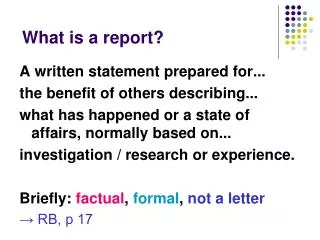
What is a report? A written statement prepared for... the benefit of others describing... what has happened or a state of affairs, normally based on... investigation / research or experience. Briefly: factual, formal, not a letter → RB, p 17
Formal considerations • LANGUAGE (register & style) • LAYOUT - STRUCTURE • USEFUL PHRASES
THE REGISTER – level of formality • Depends on the target reader • Almost always FORMAL • No colloquial phrases! • No contractions (don't, haven't, 'cos..)! • Avoid phrasal verbs (pick up, set up, etc.) THE STYLE • ACCURATE - true facts, precise, refer to sources • CLEAR AND CONCISE – avoid repetition, long sentences, unnecessary detail • OBJECTIVE NO: bias, emotional words, I,I,I USE: passive, reporting structures & narrative tenses (Past Simple, Past Perfect, Past Continuous) p 18
THE LAYOUT • Start with a TITLE • Use CLEAR HEADINGS • Each SECTION its own PARAGRAPH. • Use NUMBERS (1) or BULLETS (•) • Companies often have their own format of standard reports and do not completely follow the structure presented below. → RB, pp 19-20 – STRUCTURE → Task I → Task II → Consider the opening phrase in every section. → Study the list of phrases & do the tasks on pp 22-23 HW: Complete the report on p 24