Solving Equations Using Multiplication and Division
This guide teaches how to solve linear equations in one variable using multiplication and division. You will learn to apply these skills in practical problems while justifying each step taken to isolate the variable. Key concepts include the Multiplication Property of Equality and the Division Property of Equality, ensuring the truth of the equation is maintained when multiplying or dividing both sides. Throughout, practical examples will help illustrate how to tackle equations confidently and accurately, enhancing problem-solving abilities.

Solving Equations Using Multiplication and Division
E N D
Presentation Transcript
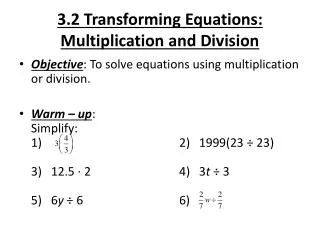
Solving Equations Using Multiplication and Division Objectives: • Solve linear equations in one variable. • Apply these skills to solve practical problems. • Justify steps used in solving equations.
Remember, To Solve an Equation means... To isolate the variable having a coefficient of 1 on one side of the equation. Ex: x = 5 is solved for x. y = 2x - 1 is solved for y.
Multiplication Property of Equality What it means: For any numbers a, b, and c, if a = b, then ac = bc. You can multiply BOTH sides of an equation by any number and the equation will still hold true.
We all know that 3 = 3. Does 3(4) = 3? NO! But 3(4) = 3(4). The equation is still true if we multiply both sides by 4. An easy example: • Would you ever put deodorant under just one arm? • Would you ever put nail polish on just one hand? • Would you ever wear just one sock?
x = 4 2 Multiply each side by 2. (2)x = 4(2) 2 x = 8 Always check your solution!! The original problem is x = 4 2 Using the solution x = 8, Is x/2 = 4? YES! 4 = 4 and our solution is correct. Let’s try another example!
The two negatives will cancel each other out. The two fives will cancel each other out. (-5) (-5) x = -15 Does -(-15)/5 = 3? What do we do with negative fractions? Recall that Solve . Multiply both sides by -5.
Division Property of Equality • For any numbers a, b, and c (c ≠ 0), if a = b, then a/c = b/c What it means: • You can divide BOTH sides of an equation by any number - except zero- and the equation will still hold true. • Why did we add c ≠ 0?
1) 4x = 24 Divide both sides by 4. 4x = 24 4 4 x = 6 Does 4(6) = 24? YES! 2) -6x = 18 Divide both sides by -6. -6y = 18 -6 -6 y = -3 Does -6(-3) = 18? YES! 2 Examples:
The two step method: Ex: 2x = 4 3 1. Multiply by 3. (3)2x = 4(3) 3 2x = 12 2. Divide by 2. 2x = 12 2 2 x = 6 The one step method: Ex: 2x = 4 3 1. Multiply by the RECIPROCAL. (3)2x = 4(3) (2) 3 (2) x = 6 A fraction times a variable: