Understanding Carbohydrate Structures: Isomers, Stereochemistry, and Common Forms
This article explores the fundamental structures of common carbohydrates, defined by the generic formula C(H2O)n where n≥4. It discusses how saccharides with identical structural formulas can vary due to the formation of isomers, including aldo-ketal types. The stereochemistry of carbohydrates is covered, highlighting the significance of linear and ring forms, particularly focusing on n=5 (furanose) and n=6 (pyranose) cyclic structures. Additionally, the piece addresses the concept of anomeric forms and compares the chair and boat configurations for better understanding.

Understanding Carbohydrate Structures: Isomers, Stereochemistry, and Common Forms
E N D
Presentation Transcript
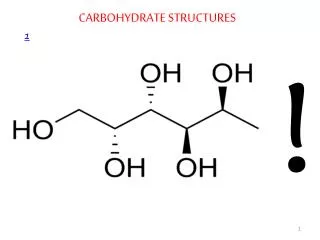
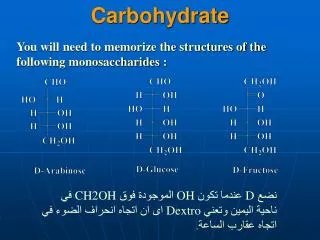
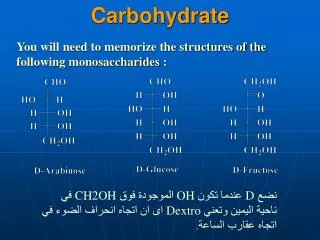
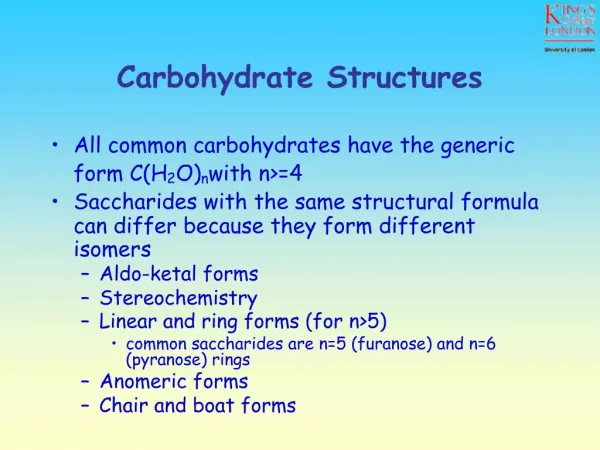
1. Carbohydrate Structures All common carbohydrates have the generic form C(H2O)n with n>=4
Saccharides with the same structural formula can differ because they form different isomers
Aldo-ketal forms
Stereochemistry
Linear and ring forms (for n>5)
common saccharides are n=5 (furanose) and n=6 (pyranose) rings
Anomeric forms
Chair and boat forms
2. Aldo-ketal Forms