Important Announcement: Homework, Midterm, and Transport Layer Review Session Details
This is a reminder for students: Homework 2 is due tonight and will be graded and returned before Thursday's class. Our midterm exam is scheduled for next Tuesday during class time. A review session will take place next meeting, covering essential topics in the Transport Layer, including TCP, reliable data transfer, connection management, and congestion control. Note that it’s a closed book exam, and only one 8.5” by 11” sheet of paper is permitted. Be prepared for tomorrow's recitation on Project 2.

Important Announcement: Homework, Midterm, and Transport Layer Review Session Details
E N D
Presentation Transcript
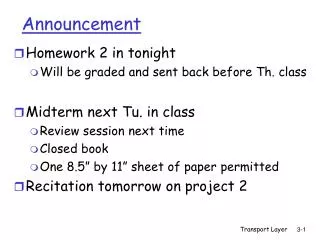
Announcement • Homework 2 in tonight • Will be graded and sent back before Th. class • Midterm next Tu. in class • Review session next time • Closed book • One 8.5” by 11” sheet of paper permitted • Recitation tomorrow on project 2 Transport Layer
Review of Previous Lecture • Connection-oriented transport: TCP • Overview and segment structure • RTT and RTO • Reliable data transfer • Timeout and fast retransmit • Flow control • Don’t overwhelm the receiver • Connection management Transport Layer
client server close FIN ACK close FIN ACK timed wait closed TCP Connection Management Closing a connection: Three way handshake: Step 1:client host sends TCP SYN segment to server • specifies initial seq # • no data Step 2:server host receives SYN, replies with SYNACK segment • server allocates buffers • specifies server initial seq. # Step 3: client receives SYNACK, replies with ACK segment, which may contain data Transport Layer
Outline • Principles of congestion control • TCP congestion control Transport Layer
Congestion: informally: “too many sources sending too much data too fast for network to handle” different from flow control! manifestations: lost packets (buffer overflow at routers) long delays (queueing in router buffers) a top-10 problem! Principles of Congestion Control Transport Layer
two senders, two receivers one router, infinite buffers no retransmission large delays when congested maximum achievable throughput lout lin : original data unlimited shared output link buffers Host A Host B Causes/costs of congestion: scenario 1 Transport Layer
one router, finite buffers sender retransmission of lost packet Causes/costs of congestion: scenario 2 Host A lout lin : original data l'in : original data, plus retransmitted data Host B finite shared output link buffers Transport Layer
always: (goodput) “perfect” retransmission only when loss: retransmission of delayed (not lost) packet makes larger (than perfect case) for same l l l > = l l l R/2 in in in R/2 R/2 out out out R/3 lout lout lout R/4 R/2 R/2 R/2 lin lin lin a. b. c. Causes/costs of congestion: scenario 2 “costs” of congestion: • more work (retrans) for given “goodput” • unneeded retransmissions: link carries multiple copies of pkt Transport Layer
four senders multihop paths timeout/retransmit l l in in Host A Host B Causes/costs of congestion: scenario 3 Q:what happens as and increase ? lout lin : original data l'in : original data, plus retransmitted data finite shared output link buffers Transport Layer
Host A Host B Causes/costs of congestion: scenario 3 lout Another “cost” of congestion: • when packet dropped, any “upstream transmission capacity used for that packet was wasted! Transport Layer
End-end congestion control: no explicit feedback from network congestion inferred from end-system observed loss, delay approach taken by TCP Network-assisted congestion control: routers provide feedback to end systems single bit indicating congestion (SNA, DECbit, TCP/IP ECN, ATM) explicit rate sender should send at Approaches towards congestion control Two broad approaches towards congestion control: Transport Layer
ABR: available bit rate: “elastic service” if sender’s path “underloaded”: sender should use available bandwidth if sender’s path congested: sender throttled to minimum guaranteed rate RM (resource management) cells: sent by sender, interspersed with data cells bits in RM cell set by switches (“network-assisted”) Implicit control: NI bit: no increase in rate (mild congestion) CI bit: congestion indication RM cells returned to sender by receiver, with bits intact Case study: ATM ABR congestion control Transport Layer
two-byte ER (explicit rate) field in RM cell congested switch may lower ER value in cell sender’ send rate thus minimum supportable rate on path Scalability issue Case study: ATM ABR congestion control Transport Layer
Outline • Principles of congestion control • TCP congestion control Transport Layer
end-end control (no network assistance) sender limits transmission: LastByteSent-LastByteAcked CongWin Roughly, CongWin is dynamic, function of perceived network congestion How does sender perceive congestion? loss event = timeout or 3 duplicate acks TCP sender reduces rate (CongWin) after loss event three mechanisms: AIMD slow start conservative after timeout events CongWin rate = Bytes/sec RTT TCP Congestion Control Transport Layer
multiplicative decrease: cut CongWin in half after loss event TCP AIMD additive increase: increase CongWin by 1 MSS every RTT in the absence of loss events: probing Long-lived TCP connection Transport Layer
When connection begins, CongWin = 1 MSS Example: MSS = 500 bytes & RTT = 200 msec initial rate = 20 kbps available bandwidth may be >> MSS/RTT desirable to quickly ramp up to respectable rate TCP Slow Start • When connection begins, increase rate exponentially fast until first loss event Transport Layer
When connection begins, increase rate exponentially until first loss event: double CongWin every RTT done by incrementing CongWin for every ACK received Summary: initial rate is slow but ramps up exponentially fast time TCP Slow Start (more) Host A Host B one segment RTT two segments four segments Transport Layer
After 3 dup ACKs: CongWin is cut in half window then grows linearly But after timeout event: CongWin instead set to 1 MSS; window then grows exponentially to a threshold, then grows linearly Refinement Philosophy: • 3 dup ACKs indicates network capable of delivering some segments • timeout before 3 dup ACKs is “more alarming” Transport Layer
Q: When should the exponential increase switch to linear? A: When CongWin gets to 1/2 of its value before timeout. Implementation: Variable Threshold At loss event, Threshold is set to 1/2 of CongWin just before loss event Refinement (more) Transport Layer
Summary: TCP Congestion Control • When CongWin is below Threshold, sender in slow-start phase, window grows exponentially. • When CongWin is above Threshold, sender is in congestion-avoidance phase, window grows linearly. • When a triple duplicate ACK occurs, Threshold set to CongWin/2 and CongWin set to Threshold. • When timeout occurs, Threshold set to CongWin/2 and CongWin is set to 1 MSS. Transport Layer
TCP sender congestion control Transport Layer
TCP throughput • What’s the average throughout ot TCP as a function of window size and RTT? • Ignore slow start • Let W be the window size when loss occurs. • When window is W, throughput is W/RTT • Just after loss, window drops to W/2, throughput to W/2RTT. • Average throughout: .75 W/RTT Transport Layer
TCP Futures • Example: 1500 byte segments, 100ms RTT, want 10 Gbps throughput • Requires window size W = 83,333 in-flight segments • Throughput in terms of loss rate: • L = 2·10-10 Wow • New versions of TCP for high-speed needed! Transport Layer
Fairness goal: if K TCP sessions share same bottleneck link of bandwidth R, each should have average rate of R/K TCP connection 1 bottleneck router capacity R TCP connection 2 TCP Fairness Transport Layer
Two competing sessions: Additive increase gives slope of 1, as throughout increases multiplicative decrease decreases throughput proportionally Why is TCP fair? equal bandwidth share R loss: decrease window by factor of 2 congestion avoidance: additive increase Connection 2 throughput loss: decrease window by factor of 2 congestion avoidance: additive increase Connection 1 throughput R Transport Layer
Fairness and UDP Multimedia apps often do not use TCP do not want rate throttled by congestion control Instead use UDP: pump audio/video at constant rate, tolerate packet loss Research area: TCP friendly Fairness and parallel TCP connections nothing prevents app from opening parallel cnctions between 2 hosts. Web browsers do this Example: link of rate R supporting 9 cnctions; new app asks for 1 TCP, gets rate R/10 new app asks for 11 TCPs, gets R/2 ! Fairness (more) Transport Layer
Shrew • Very small but aggressive mammal that ferociously attacks and kills much larger animals with a venomous bite Transport Layer
Low-Rate Attacks • TCP is vulnerable to low-rate DoS attacks Transport Layer
TCP: a Dual Time-Scale Perspective • Two time-scales fundamentally required • RTT time-scales (~10-100 ms) • AIMD control • RTO time-scales (RTO=SRTT+4*RTTVAR) • Avoid congestion collapse • Lower-bounding the RTO parameter: • [AllPax99]: minRTO = 1 sec • to avoid spurious retransmissions • RFC2988 recommends minRTO = 1 sec Transport Layer
The Low-Rate Attack Transport Layer
The Low-Rate Attack • A short burst (~RTT)sufficient to create outage • Outage – event of correlated packet losses that forces TCP to enter RTO mechanism Transport Layer
The Low-Rate Attack • The outage synchronizes all TCP flows • All flows react simultaneously and identically • backoff for minRTO Transport Layer
The Low-Rate Attack • Once the TCP flows try to recover – hit them again • Exploit protocol determinism Transport Layer
The Low-Rate Attack • And keep repeating… • RTT-time-scale outages inter-spaced on minRTO periods can deny service to TCP traffic Transport Layer
Low-Rate Attacks • TCP is vulnerable to low-rate DoS attacks Transport Layer
Q:How long does it take to receive an object from a Web server after sending a request? Ignoring congestion, delay is influenced by: TCP connection establishment data transmission delay slow start Notation, assumptions: Assume one link between client and server of rate R S: MSS (bits) O: object size (bits) no retransmissions (no loss, no corruption) Window size: First assume: fixed congestion window, W segments Then dynamic window, modeling slow start Delay modeling - homework Transport Layer
First case: WS/R > RTT + S/R: ACK for first segment in window returns before window’s worth of data sent Fixed congestion window (1) delay = 2RTT + O/R Transport Layer
Second case: WS/R < RTT + S/R: wait for ACK after sending window’s worth of data sent Fixed congestion window (2) delay = 2RTT + O/R + (K-1)[S/R + RTT - WS/R] Where K=O/WS Transport Layer
TCP Delay Modeling: Slow Start (1) Now suppose window grows according to slow start Will show that the delay for one object is: where P is the number of times TCP idles at server: - where Q is the number of times the server idles if the object were of infinite size. - and K is the number of windows that cover the object. Transport Layer
TCP Delay Modeling: Slow Start (2) • Delay components: • 2 RTT for connection estab and request • O/R to transmit object • time server idles due to slow start • Server idles: P =min{K-1,Q} times • Example: • O/S = 15 segments • K = 4 windows • Q = 2 • P = min{K-1,Q} = 2 • Server idles P=2 times Transport Layer
TCP Delay Modeling (3) Transport Layer
TCP Delay Modeling (4) Recall K = number of windows that cover object How do we calculate K ? Calculation of Q, number of idles for infinite-size object, is similar (see HW). Transport Layer
principles behind transport layer services: multiplexing, demultiplexing reliable data transfer flow control congestion control instantiation and implementation in the Internet UDP TCP Next: leaving the network “edge” (application, transport layers) into the network “core” Summary Transport Layer