Understanding Image Warping and Transformations in Computational Photography
This resource explores the essential concepts of image warping and transformations as presented in Alexei Efros's Spring 2010 course at Carnegie Mellon University. It covers parametric warping techniques, including scaling, rotation, and translation within the framework of 2D transformations. The material delves into linear transformations, the properties of transformations, and the use of homogeneous coordinates to represent various image alterations. Perfect for students and professionals in computational photography looking to enhance their understanding of image manipulation techniques.

Understanding Image Warping and Transformations in Computational Photography
E N D
Presentation Transcript
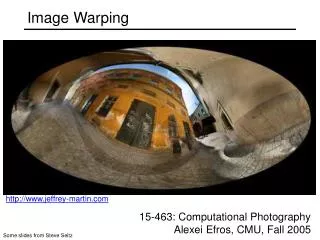
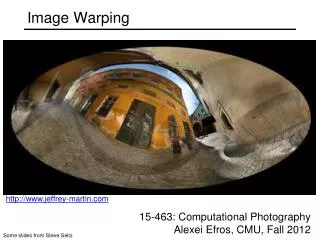
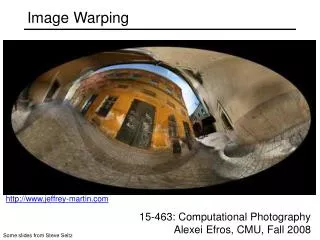
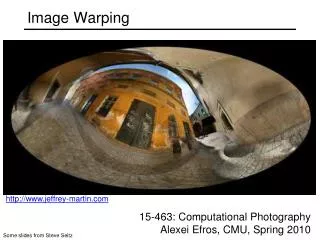
Image Warping http://www.jeffrey-martin.com 15-463: Computational Photography Alexei Efros, CMU, Spring 2010 Some slides from Steve Seitz
f f f T T x x x f x Image Transformations • image filtering: change range of image • g(x) = T(f(x)) image warping: change domain of image g(x) = f(T(x))
T T Image Transformations • image filtering: change range of image • g(x) = T(f(x)) f g image warping: change domain of image g(x) = f(T(x)) f g
Parametric (global) warping • Examples of parametric warps: aspect rotation translation perspective cylindrical affine
T Parametric (global) warping • Transformation T is a coordinate-changing machine: • p’ = T(p) • What does it mean that T is global? • Is the same for any point p • can be described by just a few numbers (parameters) • Let’s represent T as a matrix: • p’ = Mp p = (x,y) p’ = (x’,y’)
Scaling • Scaling a coordinate means multiplying each of its components by a scalar • Uniform scaling means this scalar is the same for all components: 2
X 2,Y 0.5 Scaling • Non-uniform scaling: different scalars per component:
Scaling • Scaling operation: • Or, in matrix form: scaling matrix S What’s inverse of S?
(x’, y’) (x, y) 2-D Rotation x’ = x cos() - y sin() y’ = x sin() + y cos()
(x’, y’) (x, y) 2-D Rotation x = r cos (f) y = r sin (f) x’ = r cos (f + ) y’ = r sin (f + ) Trig Identity… x’ = r cos(f) cos() – r sin(f) sin() y’ = r sin(f) cos() + r cos(f) sin() Substitute… x’ = x cos() - y sin() y’ = x sin() + y cos() f
2-D Rotation • This is easy to capture in matrix form: • Even though sin(q) and cos(q) are nonlinear functions of q, • x’ is a linear combination of x and y • y’ is a linear combination of x and y • What is the inverse transformation? • Rotation by –q • For rotation matrices R
2x2 Matrices • What types of transformations can be represented with a 2x2 matrix? 2D Identity? 2D Scale around (0,0)?
2x2 Matrices • What types of transformations can be represented with a 2x2 matrix? 2D Rotate around (0,0)? 2D Shear?
2x2 Matrices • What types of transformations can be represented with a 2x2 matrix? 2D Mirror about Y axis? 2D Mirror over (0,0)?
2x2 Matrices • What types of transformations can be represented with a 2x2 matrix? 2D Translation? NO! Only linear 2D transformations can be represented with a 2x2 matrix
All 2D Linear Transformations • Linear transformations are combinations of … • Scale, • Rotation, • Shear, and • Mirror • Properties of linear transformations: • Origin maps to origin • Lines map to lines • Parallel lines remain parallel • Ratios are preserved • Closed under composition
v =(vx,vy) p u=(ux,uy) Consider a different Basis j =(0,1) q i =(1,0) q=4i+3j = (4,3) p=4u+3v
é ù é ù u v u v é ù 4 x x x x = = pij puv ê ú ê ú ê ú u v u v 3 ë û ë û ë û y y y y Linear Transformations as Change of Basis • Any linear transformation is a basis!!! v =(vx,vy) j =(0,1) puv pij u=(ux,uy) i =(1,0) puv = (4,3) pij= 4u+3v px=4ux+3vx py=4uy+3vy
-1 -1 é ù é ù u v u v é ù 5 x x x x = = puv pij ê ú ê ú ê ú u v u v 4 ë û ë û ë û y y y y What’s the inverse transform? • How can we change from any basis to any basis? • What if the basis are orthogonal? j =(0,1) v =(vx,vy) pij puv u=(ux,uy) i =(1,0) pij= (5,4) = pxu + pyv puv = (px,py) = ?
Projection onto orthogonal basis j =(0,1) v =(vx,vy) pij puv u=(ux,uy) i =(1,0) pij= (5,4) puv = (u·pij, v·pij) é ù é ù u u u u é ù 5 x x x y = = puv pij ê ú ê ú ê ú v v v v 4 ë û ë û ë û y y x y
Homogeneous Coordinates • Q: How can we represent translation as a 3x3 matrix?
Homogeneous Coordinates • Homogeneous coordinates • represent coordinates in 2 dimensions with a 3-vector
y 2 (2,1,1) or (4,2,2) or (6,3,3) 1 x 2 1 Homogeneous Coordinates • Add a 3rd coordinate to every 2D point • (x, y, w) represents a point at location (x/w, y/w) • (x, y, 0) represents a point at infinity • (0, 0, 0) is not allowed Convenient coordinate system to represent many useful transformations
Homogeneous Coordinates • Q: How can we represent translation as a 3x3 matrix? • A: Using the rightmost column:
Translation • Example of translation Homogeneous Coordinates tx = 2ty= 1
Basic 2D Transformations • Basic 2D transformations as 3x3 matrices Translate Scale Rotate Shear
Matrix Composition • Transformations can be combined by matrix multiplication p’ = T(tx,ty) R(Q) S(sx,sy) p
Affine Transformations • Affine transformations are combinations of … • Linear transformations, and • Translations • Properties of affine transformations: • Origin does not necessarily map to origin • Lines map to lines • Parallel lines remain parallel • Ratios are preserved • Closed under composition • Models change of basis • Will the last coordinate w always be 1?
Projective Transformations • Projective transformations … • Affine transformations, and • Projective warps • Properties of projective transformations: • Origin does not necessarily map to origin • Lines map to lines • Parallel lines do not necessarily remain parallel • Ratios are not preserved • Closed under composition • Models change of basis
2D image transformations • These transformations are a nested set of groups • Closed under composition and inverse is a member