Download
1 / 20
200 likes | 356 Views
Units of Measurement. We measure everything! see table 1.1 and 1.2. Examples of Measurements. will we use numbers that big/small in class? yep! the mole. the mole. 602,213,700,000,000,000,000,000 particles or 6.022137 x 10 23 particles. scientific notation!.

E N D
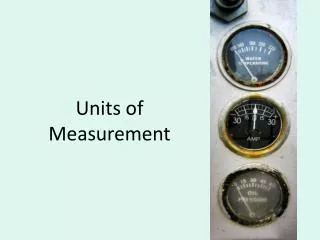
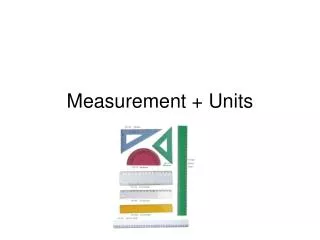
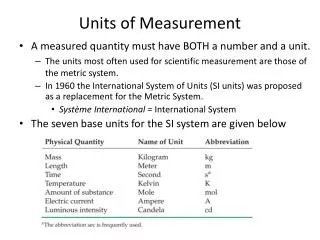
Units of Measurement We measure everything! see table 1.1 and 1.2
Examples of Measurements will we use numbers that big/small in class? yep! the mole
the mole 602,213,700,000,000,000,000,000 particles or 6.022137 x 10 23 particles scientific notation!
How to go to sci. notation Numbers bigger than ten will have positive exponents that will equal how many times decimal moved to the left 36000 = 3.6 x 10⁴ Numbers smaller than ten will have a negative exponents that will equal how many times it moved to the right 0.0081 = 8.1 x 10⁻³
Practice Write in scientific notation • 914 m • 0.000 000 000 154 g 9.14 x 10²m 1.54 x 10⁻¹⁰g
How to go from sci. notation Positive exponent = decimal moves to right 8.25 X 104= 82500 Negative exponent = decimal moves to left 1.2 X 10 -3= .0012
Practice Write in scientific notation • 2.157 X 10 5 L • 6.5 X 10⁻² m 215 700 L .065 m
which measurement is best? • 1200g • 1.200 x 10³g • 1.2 x 10³g
Significant Figures= digits recorded in measuring the more sig figs the greater the certainty
Rules • All nonzeroes are significant • Zeroes in-between are significant • Zeroes to the left are not significant • Zeroes to the right are not significant unless they follow a decimal. • All numbers in scientific notation are significant • Exact numbers are obtained by counting or definitions such as 1 in = 2.54 cm, and are considered infinite in significance
Practice How many sig figs are in the following? • 0.0950 m • 9009.0 J • 10 km • 60 sec = 1min • 5.50 x 10⁸ng 3 5 1 infinite! 3
so…which measurement is best? • 1200g • 1.200 x 10³g • 1.2 x 10³g
Adding and Subtracting Always use the least significant decimal place. example: 1253.747 + 1.1 = 1254.8 = 1254.9 round up 1253.757 + 1.1 .0365578 - .00223 = .03433 or 3.433 X 10⁻²
Practice complete the following • 8.7 g + 15.43 g + 19 g = • 853.2 L - 627.443 L = • 5.47 m + 11.0 m + 87.300 m = 43 g 225.8 L 103.8 m
Multiplying and Dividing All ways go by the least number of significant figures. examples: 1253.747 X 1.1 = 1379.1217 No 1400 or 1.4 x 10³
Practice complete the following • 4.32 cm x 1.7 cm = • 38.742kg ÷ 0.421 = • 5.40 m x 3.21 m x 1.871 m = 7.3 cm2 92.0 kg 32.4 m3
Combining the math • Follow order of operations • 55.657 -55.654 X .033 = 4.54 • 0.003 X .033 = 2 x 10⁻⁵ (1 sig fig) 4.54
Practice 8.52 + 4.1586 18.73 + 153.2 = 239.6 or 2.396 x 102 = 8.52 + 77.89 + 153.2 = 239.61 =